Showing posts with label changing the world. Show all posts

2014-02-07

Life Beyond the Societal Meme

A few things have caught my attention in the past 36 hours, and they've conspired to make me write this. Here's your red herring for the day: I've listed them in reverse chronological order, both in the origin of the words and in my experience of them.

One of the many tasks in life.
Oliver Emberton wrote up a great little post called Life is a game. This is your strategy guide. He covers some great points, like the idea of willpower as an expendable resource and the reminder to assign your time as well as possible. Bonus: I love the 8-bit graphics.

And it makes me wonder...

2013-10-31

The Rhythm of Year's End

Traditions abound. Traditions connect us with our past, with the memories of family and society. Some make sense, and some have been shuffled to the back of the relevance pile as we've moved away from the tradition's origin.
Change is the only constant in life.
                  - Heraclitus
But that's the struggle, isn't it? We pit the way it's always been vs. constant change. We hold on to our culture and holidays, even when that culture no longer functions. Even when the holidays that came from a specific world are celebrated in space, or on an alien world with endless days and nights.

It makes me wonder if a colony on Mars will celebrate Christmas.

Now here we are at All Hallows Eve. Samhain. The end of harvest, and in some traditions the end of the year. We celebrate in our own ways: dressing in costumes, consuming pumpkin beer, begging neighbors for candy, talking to trees, doing homework, or sitting in quiet contemplation as we in the Northern Hemisphere pass into the dormant cycle and start planning for spring.

It's a time for putting the past year to rest as we wait for our blanket of snow to tuck us in for hibernation.

I try to walk outside after dark and wish the trees a happy new year. I'm not sure anyone else does that, but it works for me. I take a little time to reflect and to wish us well on the next orbit around the sun. When Halloween falls in the middle of the work week, it's harder to make time.

Life goes on. Work doesn't stop. Modern society still makes the same demands on our time, but in winter we only have half the daylight to work with. We want to sleep, and yet our chosen industries want us to put in extra effort to meet our year-end goals.

And the struggle continues. We've moved beyond agrarianism, but we're still tied to the rhythms of the planet. The only change is our perception of it: Seasonal Affective Disorder expresses our bodies' earthbound rhythms, but modern medicine can overcome that now. But should we engage in chemical warfare against what we have always been?

If human bodies are tied to the planet's cycles so deeply, isn't our physiology the way things have "always been" and our societal demands the "constant change"? Who fights on the side of Tradition now?

Let's bring this into game terms and think about the ramifications of this idea for your game world.

How old is your in-game society? What aspects of your game's society remain the way they have always been? Do those constant traditions spring from physiology, environment, or society? What forces of change challenge those traditions? How does that struggle express itself during play? Are the PCs involved? What happens if PCs work for both sides of the struggle?

2013-09-01

In Praise of the Fantastic


It's been a rough couple of days. On Thursday we drove from MA to Ohio. The 11 hour drive was stressful, but we didn't run into much traffic and the audiobook of Harry Potter and the Sorcerer's Stone made the time fly by. My daughter complained of stomach issues off and on during the day, but we chalked it up to the travel. She just got through a growth spurt and her appetite had slackened a bit from that as well.

Friday I worked from 3 states away. My daughter's stomach got worse - she had the dry heaves in the morning and barely ate during the day. Reading a few chapters of The Battle of the Labyrinth made her forget about her fever and discomfort for a while, even if she barely touched her dinner.

Saturday I got up at 6 to watch my daughter pray at the porcelain altar, but no vomiting this time. Since she had a hard time getting through applesauce and dry toast, we decided to visit the emergency room.She peed in a cup and we got a $100 can of apple juice. They found no evidence of a UTI, and they told us to keep her drinking juice for hydration and caloric content.

We came home and she had a nap. Her grandparents ran some errands for a while, which gave my wife and I time to play Lords of Waterdeep. Neither of us were collecting Arcane quests, so sadly we ended up burying the Domesticate Owlbears quest, much to both of our *HOOT!*ing chagrin.

My daughter didn't eat dinner, but her temperature was normal and she ended up having a snack before bed. I got to be bad cop and made her shower and brush her teeth before bed. She cried and whined through both. I snuggled with her for a while, then she decided to snuggle with her plush Tinkerbell instead. She smiled for the first time in days. I think we're through the worst of the stomach issues now.

The house got quiet. I spend the next couple of hours reading the last half of John Scalzi's Fuzzy Nation. I laughed out loud a few times. In the silence there was me, John, and Papa on Zara XXIII with fires and explosions and finally getting the son of a bitch. It was half past midnight, and I was tired, but I felt better.

I turned off the light. And I got up to write this.

I don't think I would have made it through the past few days without the time I spent in fantasy worlds as a pressure release valve. Taking some time to be in someone else's head, watching them deal with the fabricated issues of a fictional life or struggle for control of a city that doesn't exist gives us the space we need to deal with our day-to-day reality.

We need games. We need fiction. We need different perspectives, different ideas, different inspirations. We need to know that whatever hand we're dealt isn't fixed. We need variety so our brains can make connections and solve nagging problems and continue to function.

We need hope.

Fantasy gives me hope. And inspiration. And a place in my head to regroup.

Thanks to John Scalzi, J. M. Barrie, Ed Greenwood, Rick Riordan, J. K. Rowling, and everyone else who creates for doing what you do and sharing it. Don't stop. Don't ever stop. You helped me through a rough patch when I needed it, and for that I thank you.

If anyone asks why you do something so frivolous for a living, you tell them you help people cope just before you flip them off.

And whatever you do, never stop creating.

2012-04-27

Ghosts of Cyberpunks Past

Note: This hearkens back to the rants I used to write in the dim and dusty past on Usenet newsgroups and in LiveJournal. I'm posting this here as an experiment. The fact that CISPA passed the US House of Representatives last night was purely coincidental as I wrote most of this yesterday.

Would this format work as an introductory piece to a setting or campaign? Would you like to see more of these written to detail the background of a game world? Would you like to see more of these on modern-day Earth? Would you play a Cyberpunk game set in this world? Is Cyberpunk simply past its prime, unrecognized by a world that chose a different path? Please let me know what you think.



We even trust Megacorps
to keep us in the fight.
We’ve failed, chummers. We’ve become professional pooch-screwers shuffled off into a quiet, irrelevant corner where our incompetence hopefully won’t taint the next generation.

We tipped our hand too early. We let the corporations know that we were onto them. We were going to stop the tide of corporate takeover. We would never let the world get bad enough to allow a financial conglomerate to tank an entire country’s economy. We’d prevent the dystopia or die trying. We weren’t important, the Cause was.

In our cyberpunk worlds, technology and humanity melded against the backdrop of corporate nihilism. Wage Slaves turned a blind eye to the chaos on the street. Hackers and Deckers and Riggers and Techs and Netrunners made magic with technology and turned the tide so the Talkers and Rockers and Samurai and Fixers and Solos and Facemen could apply just the right pressure at just the right time. When things went South as they always did, improvisation kept the ‘run on course. The heroes in the shadows adapted in a hurry or died trying.

These images painted the Cyberpunk world. We read these books and played these games and prepared for the inevitable takeover. We waited for that one tipping event and stood ready to rally.

Is this the Cyberpunk
Dystopia we expected?
But it never came.

Corporations learned from our Cyberpunk stories. They adapted faster than we did. They got subtle and seduced us out of our future with promises of comfort and ease and everything that money can buy. Now we’re bent over and tied down. The pain only stops when a mid-level corporate drone removes our ball gag and lets us choose the color of the next dildo to get inserted, giving us the satisfaction of participating in their illusion of choice. They limit our choices, so we usually get choices that are either A) Dookie, B) Crap, or C) Feces.

Corporations own all the outcomes. They know how we think, and they don’t let that shit get taught in school because it’s “junk science”. Crackpot or not, the science of emotional manipulation gets used against us every day. In 30 seconds, a well-crafted ad can twist your emotions and make you dance on the marionette strings in a totally predictable way. And if we want to change something, we’ve become conditioned to buying instead of making.

The disposable culture extended to manpower. We outsourced jobs, and offshored them to the lowest bidder. And now support calls for your credit cards are handled by incarcerated inmates or people who need the money rather than people who respect the job. Mike Rowe is right: We declared war on work and trained ourselves to buy something new because it’s cheaper than hiring someone to fix it when it breaks, or, heavens forbid we should roll up our sleeves and get grease on our manicured nails, learn to fix things ourselves. The quality of goods has dipped so low that the furniture we inherited from our grandparents outlasts anything we buy new through a megacorp, even with a 60 year head start on decay.

Cybereyes. Does replacing the
windows of the soul with metal
somehow make us less human?
We’ve lost our pride and forsaken our sense of responsibility. We’ve convinced ourselves that total failure is OK. We can walk away from tragedy simply by slapping up a “Somebody Else’s Problem” sign with an arrow pointing to whatever we don’t want to deal with. We’ve talked ourselves into accepting modest changes instead of sweeping reforms, which will leave our kids to make decisions in a situation that’s ten times worse. We drive our hybrids that get the exact same mileage as small cars did 30 years ago but cost three times as much because of all the new technology, and we call that a fucking win like we’re helping the solution instead of perpetuating the problem.

We’ve been trained to fear. Boogeymen nowadays take two forms: terrorists and pirates. Never mind that dying from a plane crash is eight times more likely than dying from a terrorist attack. Never mind that sharing music and video gives us common ground for personal connections in this nebulous space we call “culture”. Lesser offenses either get pushed to one of these extremes or get accepted as “the price of doing business”. We’re so afraid of the big bad world that we let corporations dictate what “safe” means. We force our culture into tiny pay-per-view boxes that very few can afford to open in the name of protecting the economy from piracy, and the spin doctors convince us that this New World Order makes our lives better.

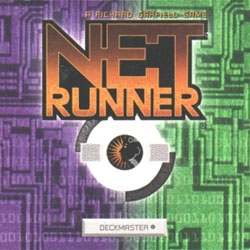
I'm still looking for Netrunner cards.
The media won’t help us. The watchdog of liberty has been bought and caged like a stray dog hungry for table scraps. Important stories drop in off the front page in a heartbeat, while asymptotic and hyperbolic soundbytes bombard us until we’re pissed at the person whose idea we ripped from its context instead of the editors who focus on the 1% of the speech guaranteed to shock the audience. And the media claims they’re innocent because they simply report the news. Bullshit. They decide where the cameras and microphones point and which clips get rerun 24 hours later. The media chooses the focus, and so it filters what stories we can focus on.

And now for the news. We’re still running out of oil, and now even faster that in the ‘70s when the energy crisis had people lining up for hours at service stations for gas rations. And all that carbon needs to go somewhere – why not into the air where we don’t see it until it kills us? Global weirding continues with stronger storms, stranger weather, and environmental backlash from places we can’t even conceive of yet.

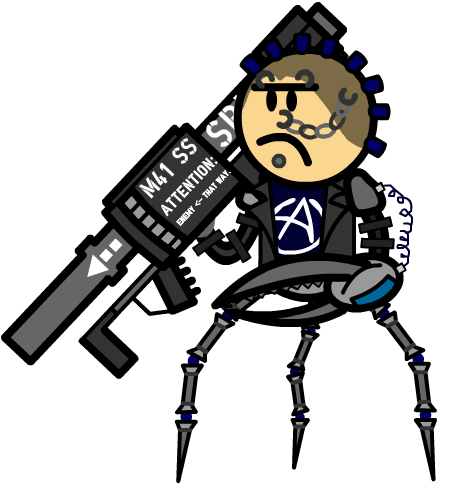
Cyberpunk characters in the
style of Order of the Stick, from
the Cyberpunk Contest thread.
But we focus on arguments about how slowly to change things so we don’t upset the corporations and their obscenely wealthy owners. Deck chairs? Titanic? Anyone?

Yes, we fucked up. We went to sleep once the specter of Mutually Assured Destruction dropped off the headlines. Once Red Menace fell apart and the Wall came down, we thought we were safe. We never thought to look within the institutions we trusted and thought were above suspicion. Without an overt enemy to fight, the paragons of democratic leadership kept starting quiet wars and twisted the organizations and agencies that were supposed to work for us into what they are today: self-perpetuating institutions of selfishness.

Another news flash: We’re a couple of years away from blood-borne nanites. We’ve been playing God medically for years, but the stakes will really kick in the afterburners with all the innovations coming down the pike. The future is here, people, and we’re too busy pouring our attention and lifeblood into paying Corporations to look around and say, “That’s fucking awesome!”

No, it's not just like the fucking Matrix.
But Green is the color of Cyberpunk.
We’re so connected now, but that’s as much curse as blessing. We retweet messages that we can’t spend the time to fully appreciate and convince ourselves that we’ve done our part to make the world better simply by boosting the signal. And what happens? Very little, and we go back to drinking from the firehose in the deluded quest to keep up with the world. We exhaust ourselves enduring the constant fusillade of information, looking for that one 140-character morsel that will give our lives meaning today. By connecting broadly, we dilute the depth of our connectivity, and we wake up in an electronic bed with hundreds of acquaintances we barely recognize.

We’ve lost focus. We always thought the cyberpunk ideal of fighting The Man would be easy – they’ve got the money and are abusing their power. Like the way “bad guys” pop off the screen – we know about bad guys. In the grey world, everybody looks the same, and people still swallow the argument of, "How can I help you succeed if you take my power and money away?" Even when the bad guy explains the plan to screw us to our faces, a part of us understands the idea as completely reasonable if misguided. There is no black and white, even when we continually ask our media to boil down complexity to overextended conclusions with only two sides. We can only conceive of two political parties, good and evil, those in power and those preparing to take power, us vs. them.

Click for a Rockerboy instrumental.
There is no “Them”. “They” are just a part of “Us” that we separate from our tribe to stay sane because we don’t want to share the term “human” with someone whose ideas we don’t like or can’t comprehend. We’re all complex people with priorities and aspirations, and sometimes we disagree with each other to the point where we stop communicating. Social media lets you sever ties with somebody else in that system by clicking a button. News flash: They still exist even when you don’t see them. Each one of us should have learned the concept of permanence by our second birthday, but sometimes we need reminders.

So yeah, we failed to keep the darkness out of the world. But we ain’t dead yet, chummers.

So now what? How can we take a stand in this post-cyberpunk world? Where do we expend our limited stockpiles of attention and focus our limitless frustration at the way things have become? What games can we make to get the masses thinking in different ways? How can we change our world for the better?

2012-04-13

PAX East: The Secret to Great Gaming

We all want to play, write, or be a part of great games. We all have some internal list of dos and don'ts to help us find great gaming experiences. But there's one ingredient consistent across all great gaming experiences that I've ever heard of.

It's the People, Stupid.
Playing with friends or like-minded strangers who will soon be friends makes for a far richer gaming experience than playing solo. I'm not going to get into gaming with people who hold definitions of fun which conflict with your definition of fun - that's a different post.

When you play a game, the real world melts away and every player ends up on an even playing field in the world of the game. There's no starstruck awkwardness, no entitlement issues, nothing else that has any useful definition in the world of the game. You play your part, whether a faction, a member of a team, or a set of colored tokens, and all that matters is that you play your role to the best of your ability.

At the Game Table, We're All Equals
What does this have to do with PAX? PAX East has the highest rate of Cool People per square meter that I know about. I have never met anyone at PAX that I have disliked.

It goes beyond that. PAX's environment encourages people to drift in and get involved with each other. We're all there to enjoy gaming in all its forms, and it pays to strike up a conversation or start a game with someone next to you in line or at a table looking bored. We all take responsibility for each other at PAX because every last person there shares a passion for gaming.

That passion trumps everything else at PAX. Gamers are the Us instead of the Them at PAX. You're allowed to be awesome in the geekiest way you can imagine. Nobody even flinches when you laugh maniacally holding a pawn above your head with that look of joy on your face. Everybody shares in the experience around the table, even if they're not playing. And that, my friends, that is magic, pure and simple.

If there's something magical about the environment, then I have to ask...

How Do We Clone PAX?
How do we create the environment of gaming inclusion? How do we get over ourselves, over the parts of us afraid of rejection, over the discomfort of reaching out to another human being and finding out if they're a member of our tribe or not? How do we generate a bubble of PAXness reliably in public without mistakenly scooping up trolls intent on controlling the situation to their exclusive advantage?

I don't have a reliable answer. But I do have friends. And I have enough space at home for 3 game tables to run simultaneously, albeit barely. So I will have Potluck Game Nights, and I will invite people over who I know will enjoy games in the company of others, and I will do my best to weed out the trolls.

It's imperfect, but it's what I have available to me, so I'll use it until we can figure out a way to reliably recreate PAX at the drop of a hat.

How do you create your zones of PAXness?

2011-07-05

Laugh, Dammit!

When did we gamers get so serious? It feels like we can't roll a d6 without running into an argument or misunderstanding out here in the wilds of the Internet. Granted, part of that is a function of the Internet, where all the bridges have gone virtual, so trolls are free to roam and stir up trouble. I'm not saying we don't deal with serious social topics from time to time, but not every topic should be treated so seriously.

The hobby is called "gaming". That seems to imply that we play games. And games should be a pleasant diversion undertaken by choice for the express purpose of having fun. So where did all the virtual dead bodies come from? And why do so many gamers say things like "You can take my 3.5 rules from me when you pry the rulebooks from my cold, dead fingers." I mean seriously.

It's a game. It's supposed to be fun on some level.

If your table is anything like mine, you hear four categories of table talk:

  1. In-character interactions.
  2. Rules questions and results of rolls.
  3. Raunchy jokes.
  4. Monty Python quotes.
Half the talk at my table makes people laugh, more than that if you count over-the-top fumbles and criticals. We accomplish in-game goals and we move the game forward, but we don't forget that we're there to have fun. As I've always said, "If it ain't fun, it ain't worth it."

I think part of this goes back to a question I've been thinking of lately. "Which came first, the gaming group or the friends?" Many people who play online or in con settings pick up the dice with complete strangers at the table. The group hasn't built a common vocabulary nor shared experiences, and in a con setting the players probably won't be gaming together on a regular basis. This makes joking at the table a risky proposition. It's possible, it's just harder to pull off effectively since people have come to the table primarily to game.

Most of my gaming experiences have been with already-established friends. We have shared experiences that we can tap and expand on in the game. And yes, joking with each other has already been established. We know each other's limits for what's acceptable and we've hammered out a social contract the overrides the game's contract.

For the level of fun and joking I enjoy at the table, I would probably be escorted to the door if I showed up to a con game laughing my butt off. That's not to say I won't interject some awful puns during play, and who doesn't like a good Python quote when it's appropriate?

In talking online, I try to maintain the same stance. I assume things should be funny. I rarely assume what someone said was designed to cause pain. I believe people are generally good, so I give the benefit of the doubt when I can. I'm not without my hot button topics, but I try to let the majority of what's said roll off my back.

You've got the choice to do the same in your online interactions. You can take everything that's said as a personal attack or malicious misinterpretation, or you can take one breath and read it again with a different voice. Try to listen for the point the author was going for past the actual words on the page, and mention the possible misinterpretations of what's written as an aside to your calm and well-reasoned response.

Years ago in the dark days before Twitter, we had an email list where we'd post cool things to a select group of friends. It's name had over 50 characters, and we all agreed to never set up an alias for it. We wanted to self-police our thoughts, so we imposed this criteria: if it's cool enough to expend the effort to type in the list name, it's cool enough to share. I miss that. That's also why I type in "Thanks!" at the end of all my email - that's not a signature file; I want to thank you for your time in reading what I'm emailing to you.

Don't we have enough problems without inventing a new holy war based around which edition of rules you like best? If you want a deadly serious game, go figure out how to feed and care for refugees in the middle of a guerilla war. But first let's stop fighting with ourselves over how many dice of damage a fireball does so we can tackle the world's truly serious problems.

Laugh, people. It's a game.

2011-01-28

Revisiting Motivation

Earlier this week, I saw a request from DNAPhil of Gnome Stew asking why we GM. His findings came together in this article. In response, I dug around and found this post from 2005 talking about different "style buckets" and giving a motivational view into at least what gives me enjoyment about GMing.

But there's more. I made an assumption in my previous post: We GM to have fun. We must enjoy it on some level, otherwise why do it? Given the grind of prep work for some games, we must realize some sort of payoff or we'll crash and burn. Does it feed an organizational need? Does the power trip of controlling an entire world give us a high? I don't know. I only know that something draws us back to the GM's seat time after time.

On an even deeper level, we GMs facilitate enjoyment for our players. We create a world/situation/scenario/game and turn the players loose on it. If we do our job right, the Muse steps in and starts directing the action to fit Her own design, and we become more participant than director. Running a really good game produces an experience larger and richer than the sum of its parts.

Sure, we can spend the same amount of time detailing a world and characters for an adventure story and probably come up with something pretty decent. In some minds, that's all a GM does. But the collaboration between GM and player creates a powerful synergy around that table (or even across Skype), resulting in the wonder of an immersive experience.

You can't get that sort of immersion from a book, or a film - this direct interaction of human ideas goes much deeper than just reading a book or watching a film. I submit that tabletop gaming goes beyond computer games, even beyond MMOs since they have limited settings that remain fixed due to constraints of mechanics or programming or economics.

Only in tabletop gaming can we come together and create universes limited only by our imaginations. And with that sense of infinite possibility inherent in our games, how can we not take at least a little of that optimism and power into our real lives?


This exchange of ideas and inherent power to change the game hearkens back to the coffeehouses and intellectual salons of ages past. So maybe Gameful has it right. Maybe the collaboration and connections we create for gaming can translate into ideas we can use to transform this shared meatspace reality we all inhabit.

Why do I GM? To change the world, one player at a time. What about you?