![]() |
| Welcome to Worcester |
2025-11-25
Designing a Settlement System
2025-10-27
Cryptid - Not-Deer (Promptober 2025 #25)
![]() |
| Artist Rendering of Not-Deer |
Appalachia holds a whole host of mysteries, but I find stories about the Not-Deer most disturbing.
It has no fear of humans and will approach them. It moves strangely, as if it's still learning to walk on its deer legs. Its eyes point forward like a predator and not to the sides like an actual deer. Its limbs stretch longer than a deer's should. Its body rounds out in a barrel shape. It has the air of intelligence about it.
True to form for cryptids, sightings usually occur at night in solitary situations by people too freaked out to open the camera on their phone. Some report being chased up a tree after they tried to scare the Not-Deer away. It stood on its hind legs attempting to gore the person in the tree, but couldn't quite reach.
So what is this creature?
2025-10-26
Aliens (Promptober 2025 #23)
![]() |
| Fantasy Aliens Within? |
In a fantasy setting, we rarely see instances of extraplanetary high-tech aliens. Early on in TSR's history we have Metamorphosis Alpha, set aboard a generational ship gone haywire, with mutated creatures and forgotten technology. We also find the classic module S3 Expedition to the Barrier Peaks, where the party discovers a crashed alien ship containing robots, odd life forms, and laser weaponry to find and use. After that, things get a little more limited in the classic D&D canon: UK4 When A Star Falls has the party recovering a meteorite for a deep gnome sage, but no actual life forms.
I tried aliens once, back in my Adris campaign. (Good gravy, that game ended about 20 years ago now.)
2025-10-20
Sorcery (Promptover 2025 #18)
| Thrice Spoken, Once Fulfilled |
Back in my youth, I read Master of the Five Magics by Lyndon Hardy as part of my quest to read every fantasy book I could. The world involves plenty of handwaving, but most of the worldbuilding went into the 5 systems of magic. Perhaps I'll explore more forms of magic in future posts, since each set of rules provides some great flavor and interesting drawbacks.
Since today's prompt is Sorcery, let's take a look at that particular flavor of magic and see if we can adapt it in a useful manner.
Sorcery in Hardy's book focuses on manipulating other minds by making eye contact with your target and reciting a charm three times. Sorcery is governed by the Rule of Three: Thrice spoken, once fulfilled. Reciting a charm in the exact same way three times seems a little cumbersome in a game with fast combat rounds, but maybe we can think about using the Rule of Three for slower magic and ritual use.
2025-10-17
Hauntings (Promptober 2025 #16)
![]() |
| What Vibes Haunt Here? |
When thinking about hauntings, images of ghosts, poltergeists, and imps spring to mind. Those are all echoes of beings of one sort or another. What if we start with something less tangible like emotions or actions? What happens when emotions haunt a place instead of beings?
Anyone with telepathy or psionics can sense an area of intense emotional haunting, but others will just have a weird feeling when entering the area. Effects can vary wildly, from simple spookiness or a feeling that someone watches your every move, to overwhelming emotions or even suffering the effects of an enchantment spell cast upon you.
Every emotional haunting is different, as is each character it influences, so reactions will vary widely. Generally, some sort of willpower resistance roll should negate the effects, like a Wisdom saving throw in D&D. If they fail, apply effects as they feel right, so let your GM intuition guide your decisions here.
2025-10-16
Do Whatever - Information (Promptober 2025 #15)
![]() |
| Sunset in Cyberspace |
Much of a tabletop role-playing game involves the gaining, transfer, uncovering, and restriction of information. Players always need more information about a scene, or where people move during combat, or what a spell does, or what effect keeps them stuck in one place, or where the next piece of the MacGuffin hides. GMs typically hide information until the characters find a way to unlock it, or make up interesting new bits of information on the fly to deepen the players' experiences.
In many ways, information provides the lifeblood of society. If a town can't communicate with its neighbors in a reasonable amount of time, they stand alone against any faster threat that arrives. And if the PCs can't communicate with each other, they each must act independently and waste effort in redundant actions.
Let's stick with the GM/Player dynamic for now.
How can GMs transfer information about the game to players more effectively?
2025-08-22
The Alchemy of Original Thought
"And the world, the world turns around.
And the world and the world, the world drags me down."
- The Cult "She Sells Sanctuary"
2024-01-20
On Cascading Ideas
I just wanted to take a moment to appreciate the cascading fractal of of ideas that fall out of one decision or moment of improvisation and lead to a broad plain of fertile fiction-land to cultivate.
I tripped across "The Humours of Whiskey" initially as this between-songs a cappella one-verse folk tune sung by Hozier. I followed it down the rabbit hole for a good hour, ending up with the six verses as recorded in 1900. And I thought, "Hey, I've got this Irish/Scottish/Gaelic country that could use more flesh, so why not include a song about whiskey?"
2023-09-17
Stream of Consciousness Game Prep
I'm trying something a little different this morning. Actually I'm doing something I usually do for creating things for my game, just in a public forum. I have a game in 4 hours, and I need to paint the next scene so the party will see something other than white when they arrive. Although a whiteout in late summer could also work, depending where the teleportation circle is...
WE BEGIN.
OK, so what do we know from last game? There's this remote ex-dragon lair with a huge portal in it up in the mountains somewhere. And we've established there's a dwarven town nearby with a teleportation circle. What else is in the area? Why is it so remote in this age of teleportation?
2016-11-22
Memento Civilis
The bearded elder remains bent over the machinery spread across the table, twiddling crystals in the splitting and refracting ruby light. "You go ahead, Avi. I'll be right behind you."
Avi's forehead creases more deeply. "You have no intention of joining me, sir. And I would remain with you."
The Archivist glances up. "I have no intention of staying here, Avi. But I have a responsibility to the memory of our people. I must use every second I can." He sighs. "Get the last of the physical records through the portal and head through yourself. You will be instrumental in organizing the archives on the other side."
2016-05-17
Eentra, The Goddess Between
![]() |
| Some call her Hecate, but her name is more ancient. |
Scholars disagree about when Eentra first coalesced, or even how she sprang from nothingness. Personally, I enjoy the thought that a disagreement over what to have for dinner first called her into existence. Berries again, or rabbit again? She has rarely let a mealtime pass since without creating a place for herself well before the food is served.
2016-03-31
Corporate Overview: Pod InterPlanetary
Started in 1056 by a small coalition of refugees to provide temporary housing on the mining world of Habiel after extreme seismic activity killed half the population. Habiel was a beta site for testing a prototype of Rapid Resource's Fabrication Unit, which survived the quakes. They tested and refined designs for the original Habitation Pod in the field, saving thousands of lives in the process. Once the crisis passed, they incorporated, started manufacturing in earnest, and sold their Habitation Pods to the governments on nearby worlds
Rapid Resource ceased operations as of 1/1059, and PodIP purchased all assets and technologies later that year. PodIP further refined the capabilities of the Fabrication Unit and pressed it into service in their factories. In 1062 they diversified, opening a chain of Pod Shops to provide custom parts fabricated on demand for starships, mostly merchants and scouts, and especially older out-of warranty ships. PodIP's Pod Shops won Innovator of the Year from the Corinth Planetary Chamber of Innovation in 1063.
Products and Services
PodIP started by manufacturing self-contained living spaces. With the purchase of Rapid Resource, they started offering on-demand fabrication services. Rumors abound that the two business units will break into two different companies, but other experts contend that improving and distributing their manufacturing processes yields great synergy with the manufacture of their core Pod products.
- Habitation Pods (also called Habs) provide basic shelter in extreme conditions, along with breathable air, drinkable water, and edible food. These 5 ton modules ship easily and deploy nearly anywhere, providing short-term basic comforts for up to 4 sentients. The entire construction is modular, so cobbling together a working HabPod from two broken ones is relatively easy, and hooking together several Habs with a pressurized "spine" corridor is trivial.
- Vagabond Pods are the luxury versions of Habitation Pods. They're designed as portable homes for well-to-do clients. They're a fraction of the cost of a starship, but they provide the same opportunity for adventure and exploration with all the comforts of home. Vagabond Pods have found a following among sentients who want to travel in style, but don't have the means to afford a starship of their own. PodIP is always working on upgrades and options for customizing Vagabond Pods for their clients. Bespoke design services are available for an additional fee.
- Pod Shops provide retail-level custom fabrication services for commercial and private spacecraft. Provide the specifications for the part, and a Pod Shop can deliver a replacement within a standard day. Some complex parts may take longer. They recently stopped providing critical parts for jump drives for liability reasons. (Editor's Note: Search for the Alexa Pride's misjump in 1064 and related investigation for background.)
- FabPods create custom spare parts on a starship, eliminating the need to maintain an onboard stockroom of parts. FabPods, specifically the storage systems for the various fabrication media, are cutting edge technology currently being tested by the Subsector Navy. The technology has been classified. Possession of this technology outside of PodIP and Navy facilities is considered treason. The Scout Service is understandably upset about this arrangement, as they would greatly benefit from the added autonomy FabPods could provide their scout ships.
Their first product, Habitation Pods, still sell well. Several planetary governments have contracts for keeping these on hand and well-maintained in case of emergency. Some have been modified for prisoner transport by government, bounty hunters, and private security forces, but you will be hard-pressed to find that application anywhere in PodIP's marketing materials.
Vagabond Pods have caught the eye of the idle rich and off-grid travellers alike, and sales are trending higher. Innovating various Pod designs has become a diverse Maker Community effort, spreading across the subsector and far beyond. The used Vagabond Pod market is hungry for more product, so much that PodIP has released registration information to planetary authorities to prove original ownership in several criminal cases involving Podjacking.
The service arm flagship Pod Shops are spreading from world to world as leasing deals are signed. Various law suits throw a small hiccup into their expansion plans, but most starbases jump at the opportunity to offer custom replacement parts within a day instead of stranding their customers for weeks until a part comes in from offworld.
Results of FabPod testing by the Navy will probably remain sealed, but various anonymous sources involved in the testing report overwhelmingly positive results.
Overall Outlook
If the Navy finishes testing FabPods and starts installing them on every ship in the fleet, PodIP's earning potential is effectively limitless. If the Navy doesn't want them, the Scouts will pay nearly anything for the technology to keep their survey ships in the field for more involved missions.
Sales at Pod Shops have steadily increased for the past 2 years, despite the Alexa Pride's jump drive mishap. Habs and Vagabond Pods are both exceeding sales expectations. PodIP is well-capitalized with a board of directors that makes level-headed decisions. They're poised for massive growth throughout known space, though they're consciously throttling growth to build and maintain effective supply lines and system redundancy.
If you have any excess capital, investing in PodIP should reap excellent dividends.
2016-03-30
Vagabond Pods from PodIP
In the spirit of human wanderlust and ancient Terran tiny houses comes the cheapest way to tour the galaxy in luxury: Vagabond Pods from PodIP. These sealed-environment pods contain all the comforts of home, and they fit in the cargo bays of most ships. Just pay your captain a delivery fee (a fraction of what you’d spend on a high passage) and you can live anywhere in five-star luxury for the cost of a weekly warehouse rental.
2016-03-29
TAS Memo: Vagabond Travellers
![]() |
| Early 10 Ton Vagabond Pod Prototype. By Johantheghost - CC BY-SA |
MEMORANDUM
For immediate distribution as of 314-1066.
To: All Society Staff
Re: Vagabond Travellers
BE IT KNOWN:
It has come to our attention that a movement called Vagabonding is capturing our membership's collective imagination at an impressive rate. These Vagabond Travellers, so called because they ship themselves around the galaxy as cargo in sealed habitat modules, have recently made requests of the Society on several worlds to help procure safe and reasonably-priced storage facilities.
This memorandum will inform all TAS staff on the official stance toward Vagabonds.
2016-03-28
Personal Note: Sudden Proliferation
Over the winter I was lucky if I had inspiration for an article a month. Spring showed up and brought a bounty of ideas with it. So here I sit, swimming in ideas and actually carving out the time to develop and record them.
It feels glorious.
2016-03-17
Classic Traveller: Grav Scooter
I'm sure this has been done before, but I didn't see anything in the Classic Traveller Little Black Books that fills the niche between an air/raft and a grav belt. Surely there are cheap gravitic knock-off vehicles designed to go really fast with no concern for the pilot's safety? What else would down-on-their-luck teen nobles try to kill themselves with? And with so much lifting power available so cheaply, how could this not bleed into the cargo market on poorer worlds?
2015-02-24
[Toolbox] GMing Links
On Economics
Building Your World: Economics Overview for Fantasy Writers (non-technical) explores world economics in terms of World of Warcraft's quest rewards, monster loot, crafting, and auction house mechanics. It's a great way to simplify thinking about the economies in your tabletop game.
2014-10-15
Robin Williams Makes Memorable Characters
While it doesn't give us many practical pointers on how to cultivate your improvisation skills (other than implying "practice, Practice, PRACTICE!"), it demonstrates a skill used by every RPG GM: characterization. Every character Robin assumes sticks in my mind. They're not throw-away, one dimensional characters. They're rich and unexpected and fresh, and they establish themselves clearly within one spoken sentence.
Why?
2014-10-10
Fate of the Speculative Trade
Caveat Emptor: These are scribbled notes that I made on a train ride into work. No playtesters have been harmed in the creation of this system, nor have any playtesters even been contacted. And yes, hard trade and money can be handled through Aspects, but I figured I'd write it down anyway if ever a full Traveller's Fate game made it out of my head. Feel free to use this hack and let me know how it works for you.
Q Notation
As a quick refresher on Q rolls, you need 4dF made up of 2 pairs of dice in 2 different colors. Pick a pair to be your "shorter" axis. Roll 'em.

| Notation | Meaning |
|---|---|
| dF | Fudge Die (-, 0, +) |
| dT | Tally Die (0, 1, 2) |
| QF | 4dF (-4 to +4) |
| qF | 2dF (-2 to +2) |
| QT | 4dT (0 to 8) |
| qT | 2dT (0 to 4) |
2014-10-03
Divided Multi-Axis Fate Rolls
Rob indicated he has more to go in fleshing out uses for Tally Dice. Stay tuned to his blog The Walking Mind to read more as it comes out.
![]() |
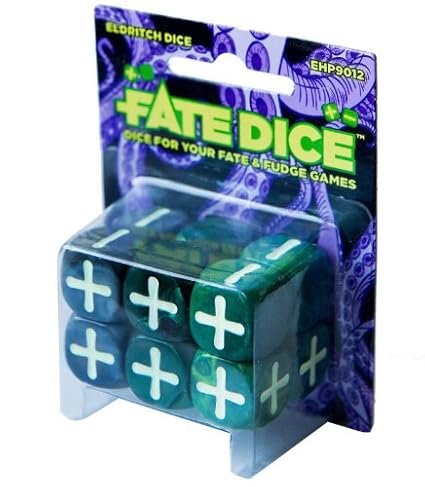
| If you don't have a set yet, go buy Fate Dice at Amazon or directly from Evil Hat. |
Intro to Tally Dice
Rolling 4 Fate/Fudge dice (4dF) gives you a range from +4 (++++) to -4 (----) with a curve that peaks at 0 (+00-, for example). Tally dice (4dT) changes the way you read each die (into 1d3-1) by counting lines. 0 is still 0, but - is 1 and + is 2. It gives a range of 0 to 8. It's fundamentally the same as 4dF+4, or XdF+X.
NOTE: I'm basing all the numbers in this article on 4 dice, but you could certainly change the pool size if needed.