2012-08-25

Schrödinger's Gun GMing: The Power of Perception

Welcome to another article in the Schrödinger's Gun GMing series!

Note: This article was started in August 2012. I got inspired and finished it on the train this morning. Yay, persistence!

For clarity, no, the title doesn't mean I'll be writing about how cool the Perception skill is. A while ago I watched this TED talk given by Rory Sutherland in Athens. It's over 18 minutes on marketing and advertising, so come back later if you like.


If the embedded video is blocked, you can see it on the TED site. This ties in with some much earlier thoughts I scribbled down about The Rules vs. The World vs. The Game and the idea from the more recent Schrödinger's Gun GMing series that nothing is real in a game unless the PCs observe it somehow. For this article, I'll focus on perception and observation.
Perception Is Reality.
Any charlatan or con man will tell you this, but let's go a little beyond that here. To tie it to Quantum Theory, I quote the words of Pascual Jordan, "Observations not only disturb what is to be measured, they produce it." Starting in the quantum world, we take a few liberties with language and produce a new 3-word phrase:
Observation Creates Reality.
Note to self: Gather brains, clean carefully, and then reinsert into skull. Order is key.

The Delayed Choice Experiment
We can see this phenomenon illustrated in the Delayed Choice Experiment. For those of you who don't know it, here's a stripped-down layman's version.

Did someone say "Duality"?
Found at ThinkGeek.
Light acts as both a particle and a wave, something called duality. We have ways of detecting which way light acts at the moment. For simplicity, let's say we have a Particle Detector and a Wave Detector. If we release a single photon into a controlled environment with both detectors running, only one of them will ping, telling us that this bit of light is acting as a wave or particle. With me so far?

Now here's the funky part. If we release a photon into a controlled environment (so we assume it's already acting as either a wave or particle) and later decide which detector to power on, whichever detector we use will ping. If we power on the Wave Detector, the photon will act like a wave. In other words, the photon changes the way it acts depending on how we detect it. In this experiment, the way we look at light determines the way it acts.

Some say this breaks causality since a later observation seems to dictate the way the particle was created in the past, and there are other factors to consider, but I'll leave that for the more theoretically-minded to puzzle out. At the moment I'm focusing on the idea that looking for something causes that same something to exist.

What Does This Mean for RPGs?
Whenever a player asks for information, that question shapes the reality of the game world. For example, "What color is the man's socks?" This innocuous question forces several things into game reality that weren't there before the question was asked. 1) The man is wearing socks. 2) The socks are colored. 3) The man must have put these socks on earlier when he got dressed. 4) Someone made these socks. 5) If the man didn't make these socks, someone sold them to him. 6) Those are cool! Where can I buy my own socks?
It's usually not quite this dramatic.

It's up to someone else (usually the GM) to validate the existence of the socks and respond with what color they are, and then scramble to fit a sock shoppe in town when the party goes looking for one.

Here's the thing. Sock shoppes didn't exist in the game world until the player asked about the man's socks. In the game world, observation created reality, or more precisely, asking questions created reality.

Sure, socks make a flimsy example, but I think you can see the power of this concept. And yes, the GM could cut prevent the creation of that reality by responding with something like, "The man is wearing sandals and no socks." But I'll operate on the assumption that the GM responds with "Yes, and..." in this case. *POOF* Instantly sock shoppes exist.

Meanwhile, on a Psychological Level...
Beyond that, the player asks questions to find meaning in their character's surroundings. The player spends time finding patterns, creating tools, discovering hidden information, or doing something that will help the character overcome game world obstacles on the way to a goal. So every time a player asks a question or responds to a game-world stimulus, that action reveals what the player is interested in exploring through the lens of the character, and it gives clues to the GM on how to more fully engage that player. Aside from creating details about the world, questions can lead to a more engaged and deeper experience of play.

Yes, there's plenty to unpack here, and I'm not going down that road at the moment. If anyone wants to follow up on some of these ideas as a dissertation, you're welcome. *grin*

Final Example: A Short Film
Our life and our reality comes from what we experience, and we experience only what we pay attention to. For further illustration of this idea, take a look at this short SF film "Blind Spot".


Thanks for reading!

Go to the Schrödinger's Gun GMing Cover Page.

2012-08-24

Schrödinger's Gun GMing: Monsters on the Fly

Welcome to another article in the Schrödinger's Gun GMing series!

So far we've talked about letting go of your GMing preconceptions about where an adventure begins, about Plot Points and making a Plot Stack for your game, and about Carrots and Sticks to motivate your PCs. Now that the party is engaged with the plot, what challenges do you throw at them?

For D&D and the vast majority of RPGs in general, the most common challenge standing between the party and its goals involves monsters. From lurkers who harry the party as they try to do something else, to stand-up soldiers doing their job for the Hobgoblin Army, to guards working for a megacorp, to the brutal giant alien that taxes the party to its limit, to the minions that protect the evil mastermind, to the dragon attacking the village, monsters come in all forms. You've got boss monsters for your major plot points ready to go, but how do you create something relevant to the situation and work out the numbers on the fly?

You could plow through a rulebook and refer to the monster's stats, but that wastes time as you flip through to find what you're looking for. Can you really fit another book propped open behind your GM screen? If not, you'll need to spend the time and copy the relevant stats to note paper. Also I've found that what's in the book rarely lines up exactly with what I have in mind. My solution? Break out your index cards and improvise!

How to Create and Use a Monster Stack.
The ever-handy 3x5 index card works for my style of GMing so that's what I use. I'll assume we're using index cards, but please use whatever format or technology works for your style of GMing.

1) Choose Base Monsters (Game Prep)
You know your world. You know the beasts and races that make up your world. Sure, there may be infinite variation to your world's flora and fauna, but it's unlikely you'll trip across a colony of Shambling Mounds in the middle of the desert, nor a clutch of demons spontaneously appearing in the middle of a busy street. These are plot-level decisions. If they happen, there needs to be a good in-game reason for it or the players won't buy into the reality of your game world.

Or, y'know, Drow with Sword, Drow with Bow, and
their erstwhile companion, Drow with Spiked Chain.
Take a moment and think about the monsters that your party is likely to fight over the next few sessions. Chances are you'll come up with only a handful of basic critter types. And when I say "critter types", you can take that as species (goblin, dragon, piercer, etc.), or you can take it to mean type (lurker, artillery, brute, etc.), or a blend of the two (Kobold Rogue, Drow Sniper, Fire Giant Warrior, etc.). Use whatever delineation makes sense to you, but stick with a handful of basic types. For instance, if you're going into a Drow settlement, chances are you'll meet nothing but Drow, so I'd go with Guards, Priests, Wizards, and Rogues.

Once you have your basic monsters, assemble game scores for them as needed. You can set this up however you want, but I've had good luck with 3x5 index cards in my D&D 3.5 game. As a bonus, the 3x5 cards stack well, so they serve double duty as my Initiative Stack in combat.

2) Make Templates (Game Prep)
Now that you have your base monsters, choose how they may be different and unique. I'll call each modification a Template, but it can be whatever change that makes sense - new skills or descriptors, different powers, a new weapon package, Enchanter instead of Evoker, whatever you need to throw curve balls at your party.

Art by UrsalaV.
Template by The Looney DM.
Most templates you already know how to make. For example, a Fire creature would use fire instead of any other energy type, be resistant to fire, and may have a damaging aura if they're actually on fire. A Berserker creature may have 20% more hit points, a couple points of damage resistance, an ability that lets them ignore special effects, and a huge axe that does an extra 1d8 of damage on a hit. Someone with a Sword of Shadow may be able to hit incorporeal targets and do +2d6 negative energy on a hit.

Note: Don't include percentages unless you're really quick at basic math. You'll save time simplifying to "+20 hit points" instead.

Whatever set of abilities and powers makes sense to you, note it down. If you use a 3x5 index card you can paperclip the template directly to the base monster. Just make sure your templates are easily accessible in whatever format works for you.

Pro Tip: Normalize!
I've normalized my share of databases in my time. One of the points of normalizing data is to avoid redundancy. When making monsters and templates, you want to make a few very flexible cards instead of a pile of single-use cards. If you have several monsters or several templates that do almost the same thing, then don't bother keeping them separately.

For example, if you're running an adventure in The Elemental Keep, you'll probably have several energy type templates. If each energy template adds 5 resistance, +1d6 energy damage, and an aura 1 that causes 1d6 energy damage, then I'd boil it down to one template called "Energy Creature". You can keep a list of energy types at the bottom of the index card. Now you have fewer cards with much more flexibility.

Unique boss monsters are a different story. You want your big monsters fully developed as solid story points in your game. I keep mine on index cards for later reuse just like base monsters, but I tend to improvise less with them. If you've already got an Infernal Black Dragon, adding a Cold template doesn't really seem to add anything except needless complexity.
1) Say "Yep, that would suck."
2) Show them this picture of Hugo.
3) Watch them cry.

3) Describe Monsters (Runtime)
When you need a monster at the table, forget about stats for a minute. Listen to what the players are expecting to see - sometimes they blurt it out and save you the trouble of guessing, like, "Boy, wouldn't it suck if that Ogre Barbarian was hiding right around this corner?" Take a look at the situation and ask yourself what would make sense.

Once you get a picture of what's hiding there for the PCs to fight, describe it as they experience it. This is most commonly a visual description, but don't feel limited to colors and sizes. "You feel something slimy brush your leg, then it's gone," works just as well. Use all the senses to describe texture, temperature, smell, noises, shaking ground, battle cries, sharp claws, crazy eyes, and flailing tentacles.

4) Assemble Your Critter (Runtime)
With your description in mind, pick a base monster and zero or more templates. If this is a quick encounter meant to slow the party down, a base creature is fine. If you introduce one of the guard captains, pick a template to make the encounter a little more challenging and unique.

When you choose a base monster, don't feel limited to what's described on the card. If y, feel free to use whatever stats come close and literally reskin the monster as a different race. If ou need human 4th level fighter guards and all you've got for prepped base monsters is an Ogre, use the Ogre's stats and swap in a long sword for the greatclub. If you need a juvenile Hill Giant, lower the damage a bit and use your Ogre stats. I've used a halfling Conjurer boss from previous adventures as a Drow Wizard guardsman who led with Acid Arrow and could summon spiders. The stats were close enough and it saved me the trouble of picking out spells in D&D 3.5.

Assembling a critter is as simple as choosing the index cards for the base critter and whatever templates you want to use. Use your best judgement and try not to overdo the templates, especially for quick or random encounters. Scribble the adjusted numbers down, and you're off to the races. With a little bit of prep work, you've just hacked a creature together to order in about a minute.
Just be sure to keep all
your knives in the air.

Pro Tip: Going Beyond Templates
If you really go off the rails, feel free to make up stats as you go. If you need to extend your fire template to make the critter immune to cold as well as fire, have at it. Adding a breath weapon and a vulnerability to wooden weapons? Go crazy as long as it makes sense in the situation. If you don't have a good template set up for what you want to do, wing it for now and prep a new template before your next session.

When winging it, look at the templates you've already made. Chances are you'll notice some patterns in the bonuses, like most templates grant a +1d6 damage bonus or base monster stats only change by 25% at the most. Use these guidelines to tweak your monster however you need to so it will fit the situation and the story.

Caveat Emptor
I wouldn't rely on this technique to create truly unique monsters. It's great as a start, but a one-of-a-kind boss monster will benefit from slightly more design work than hacking together a couple of templates.

When winging stats, remember that "different" and "harder" don't always mean "bigger" or "nastier". There's nothing terribly fun about fighting something that's impossible to kill, and if everything turns into a slaughter you're missing some great opportunities to throw social curve balls and moral dilemmas at the party.
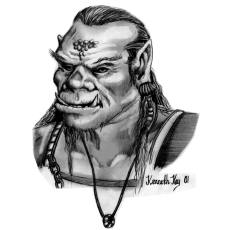
I once made an orc wizard NPC who researched all things Dwarven in his quest for more power and greater knowledge. He tried to hire himself out to the PCs after escaping the slaughter of his clan. The party rebuffed him, thanks to the racial tendencies of the Dwarf among them. He ended up becoming a servant to a powerful Gnomish Alchemist, who changed him into a human so he could easily take part in human society. Instead of a one-encounter speed bump on the way to next level, his story got the players to question their motivations, however briefly, and he became a recurring not-quite-trusted NPC with a really cool backstory.

Wrapping Up
By investing some time in a tool kit for working with monsters on the fly, you make improvisational GMing much easier on yourself. The more base monsters and templates you make, the faster you'll be able to adapt something from your library to put into play immediately. Limit yourself to a handful of base monsters and templates during a particular session so you don't suffer from analysis paralysis, and feel free to swap monsters out if you get a minute of downtime, particularly if the party suddenly changes direction.

The main drawback to this method? It's a system-specific approach to monsters, and as such it's much better suited to campaign play rather that one-shot adventures. But there's no reason you couldn't run a sandboxy one-shot with nothing but a monster stack. You can keep a stack of Pathfinder monster cards next to your D&D 4e monster stack. It's just a little more prep work, and you get the advantage of cross-pollination when you adapt monsters between systems.

Have you used something similar in your games? How did it work for you? What did you use? Index cards? A spreadsheet? If you try this approach to running monsters on the fly, I'd love to hear how it worked for you in the comments below.

Thanks for reading!

Go to the Schrödinger's Gun GMing Cover Page.

2012-08-22

Non-Sequiturs, Inspiration, and Blowing Off Steam

So I had a non-sequitur tweet-off earlier this evening with the inimitable Tracy Barnett, the driving force behind Sand & Steam Productions. It's been a long day and I needed something to jar my mind out of the rut it had been in all day. Apparently all it takes is one simple statement and the will to continue, and suddenly you get something like this...
  • @TheOtherTracy: All I feel like doing right now is tweeting non-sequiturs.
  • @twwombat: Lemon Lemurs?
  • @TheOtherTracy: Biscuit disco.
  • @twwombat: Mother Pheasant Plucker.
  • @TheOtherTracy: Chain-link gazebo.
  • @twwombat: Aquarium Mousetrap.
  • @twwombat: Though I think we may be straying into band name territory.
  • @TheOtherTracy: Mousse-based dental work.
  • @twwombat: Handcart congregationalism.
  • @TheOtherTracy: Band name is the name of my previous left shoe.
  • @twwombat: ...in the whisky shower.
  • @TheOtherTracy: Logical bean trails.
  • @twwombat: "Bucky" Bradbury, western futurist.
  • @TheOtherTracy: Leftover band-aid gravy.
  • @twwombat: We Are The Hamlet's Father's Ghost In The Machine
  • @TheOtherTracy: Blanche the grapes until the supine threshold has been reached.
  • @twwombat: Subluxate the metatarsals, submerged in Napalmolive.
  • @TheOtherTracy: To be, or slap someone on the wrists for yodeling.
  • @twwombat: Having the consistency of bran.
  • @TheOtherTracy: Blank stares into the vorpal netherdrome.
  • @twwombat: Folded left-handed Huxleyism.
  • @TheOtherTracy: Lacking the Proust of our yestergenerations.
  • @twwombat: Pulling cotton candy from the tentacled maw.
  • @TheOtherTracy: Zebra-striped blazing adjectives with buttery steeliness.
  • @twwombat: Doing the tonsil cha-cha with garlic-stuffed olives.
  • @TheOtherTracy: I think you win. I'm sequitur'ed out. Well done! =)
  • @twwombat: Awesome! I was about to concede so I can get my daughter bathed.
  • @TheOtherTracy: This slice of non-sequitur theater is brought to you by #SchoolDaze. Pick up your copy here!
  • @twwombat: And definitely well-played, sir!
  • @TheOtherTracy: Thanks!
  • @twwombat: Thank =you=! I needed something silly after this frustrating day.

Buy this from Tracy.
Seriously.
One statement fed into another as tangents grew tangents, and the ridiculousness kept making me laugh. Now our exchange is preserved for posterity, as if this little bit of fluff needs a solid remembrance. Yes, I took editorial liberty with the order of things, but at least there are no issues with changing the order of a stream of non-sequiturs like this.

Now let's take it one step further.

READER CHALLENGE: Pick one thing (word, concept, syllabic cadence, anything really) from this unrelated pile of absurdity and turn it into a game element, whether for Paranoia, Gamma World, School Daze, Call of Cthulhu, or whatever your fevered brain can think up. Post it somewhere and let me know about it in the comments.

Inspiration can come from anywhere if you let it. Even otherwise frivolous interactions like this. Now go shake your idea tree and let fall what may.

Meanwhile, In The Game Box...

So I'm dealing with a VPN issue which makes working nearly impossible. I'm waiting for updates to install, and I dig out my Game Box.
The Game Box
Yes, that's my original name tag from freshman orientation at WPI way back in 1987 on the lid. I open it, which I haven't done in a while...
Idea Treasure!
...and I start digging. I find my old Hero System binder for the modern-day game...
This is Blade. He's basically Wolverine
with more sharp edges and more issues.
...and I see the character sheet for Gregor Ramon, a swarthy chap. He's a gypsy art thief, one of Derek's characters. Derek has been gone a long time, and losing him still cuts me when I least expect it.

Digging deeper, I find Aurora's Whole Realms Catalogue, which still rocks.
Still a great resource for fantasy gadgets
and high magic pseudo-steampunk inventions.
And I found the 7-pointed star of correspondences, lining up my system of gods, colors, WoD magic spheres from Mage: The Ascension, Chakras, and Egyptian souls.
And this is why an Elder Sign works.
It doesn't have Time nor Prime, so it'll eventually fail.
For those of you wondering how a systems guy tries to make the world fit together, keep staring at the star until something clicks for you.

I found the notebook from my several Highcastle games, started back in 1985.
Highcastle and northern environs.
Includes the Rat Cave, where normal rats
made for the scariest adventure ever.
The Tomb of Tor-Kantor.
He's an insane undead elven general.
The PCs lived, but set him free to seek revenge.
I even kept my visual aids from when the Lizardmen and Dragons tried to invade Highcastle.
Priests of Kreigan try to cover for the
routed conscript spear units, heading for the walls.
I remember they had to rebuild a few wall sections after the battle, but they held firm and pushed the invaders all the way back into the sea, 20 miles away.

I even found some magic items I had made and transferred to 4x6 index cards for reference.
This is Water Brand, a Footman's Mace
with a Decanter of Endless Water in its head.
And yes, I colored the pictures in my Player's Handbook. At least I used colored pencils and not crayons.
I'm never selling it.
Don't judge me. You did similar things.
Every piece of paper holds something precious. The smell of old line printer paper, a scribbled map, a jotted idea, photocopied flags of Japanese Prefectures. Research of things never quite real to begin with, but cast in concrete memory of challenges and laughter. And I miss diving into the guts of a long campaign and juggling the rest of the world while the players dance on center stage.

So that's the photo diary of this morning's trip into my Box of Games Past.

What's in your archives?

2012-08-20

All I Want for Christmas is the Next Basic Set

Dearest D&D Next Design Team,

I've downloaded the latest D&D Next playtest materials with the Sorcerer and Warlock. I started reading the PDFs and I started ticking items off my mental checklist of what was in there:

  • Basic Character Classes? Check.
  • Character Creation Rules? Check.
  • Notes on How to Play the Game? Check.
  • A Starter Pile of Monsters? Check.
  • Treasure Tables (even though some are copied from the AD&D books)? Check.
  • Experience Rules to Advance Through Level 5? Check.
  • A Demo Module (actually two of them with the Caves of Chaos)? Check.
All we need is a few starter traps, a fold-out map or poster, and a set of dice. Then you know what we have?

A D&D BASIC BOXED SET.

If we're talking about a modular ruleset, and if we have the system basics buttoned up with this playtest, it seems like we can push off more advanced topics and more complicated rules to other sets or supplements, right? If that's the case, can we get a Basic Set in time for the Christmas rush?

Consider: This'll be a shot in the arm revenue-wise, rather than stringing the playtest along for another year while everyone waits for a product to ship. You may hook a younger crowd with a boxed set in time for Christmas - something that was missing from 4e, I think. And future sets can roll out as the years go on. it's a softer launch with a clear upgrade path, both in game play and product line.

On Rolling Power Levels
In my mind, waiting to design the whole system before shipping any of it works if there's not a large power scale. Amber Diceless or FATE or any of a pile of Indie games fits this category. D&D really doesn't. the role of a character changes as they level up. Sure, there are still larger monsters, but if that's the only challenge facing the PCs, the players will get bored. At Paragon, the PCs become movers and shakers in the world, but their role is still handling wetwork for existing rulers? I don't buy it.

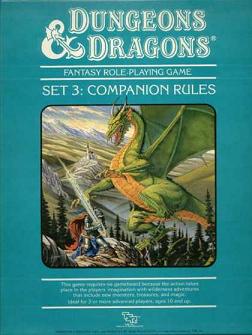
The Tier system in 4e makes sense, but I'm not sure it went far enough compared with the old BECMI boxed sets. Paragon makes sense for introducing leadership and land ownership, but nothing of the sort came out for 4e. Under BECMI, once you hit name levels you can own castles and run your own fiefdom as spelled out in the Companion set. And since every rule is a guideline, they can still leave their holdings in the hands of a trusted regent or steward and run off to beat up the occasional big bad monster.

I'd love to see guidelines and systems for letting PCs ascend to godhood and still remain playable. In the old Immortals set, you only directly challenge truly unique monsters and rarely at that. The rest of your time is spent competing with other gods for followers and sources of power. It's still very much questing for power, but it's a very different game. Even so, it still reads as D&D if it's done right.

Disclaimer and Plea
I don't know what the plans for D&D Next are, nor am I affiliated with Wizards of the Coast in any way that I know other than "Playtester". I have zero pull on the design process other than aggregated responses to a questionnaire. But the more I think about approaching D&D Next as a linked series of sets based on power level, the more I think this is the way to go, especially in the short term.

Is it even possible to get something on the shelves by this Christmas? Electronically, definitely. But for traditional distribution I just don't know. I'd love to see it happen in some form, but I'm not holding my breath.

Having a Rules Cyclopedia after all the D&D Next sets come out would rock. The old Rules Cyclopedia is one of the hardest supplements to find on the secondary market, which speaks to its lasting value.

I don't know what internal discussions have happened on what D&D Next is going to look like in terms of product line, but please consider the BECMI model. Other non-core set rules modules can come out as quick PDFs or inexpensive small paperbacks. I'm not sure there's a need for a slim hardback for one focused rule expansion.

If we're going modular, let's try for the smallest units possible like when normalizing a database. New players can pick up the basics with one product and then add on whatever they want to play with from there. Cheap entry, but deep product line, and a happy customer base no matter how much they happen to buy. Everybody wins.

Thank you for reading this open letter. This thought just had to come out of my head today or there would have been trouble in Wombat's head. Nobody wants that. Also thanks to the folks in the Gamer Assembly chat for encouraging me when I first brought it up, specifically Fitz and Adam. Even the smallest feedback is greatly appreciated.

As for you on the Next Design Team, keep up the great work. I can't wait to see what's next with Next.

Thanks,
  -T.W.Wombat.