Showing posts with label Kids RPG. Show all posts

2013-03-04

Kids RPG: Lessons Learned II

Session 2 was much more challenging than the first session. There were more kids at the table, and attention tended to wander toward bathroom humor. Huh. That sounds like some adult groups I've played with. This session's lessons seem simple, but have a big impact.

And if all else fails, throw hordes of
negative energy squirrel ninjas at 'em.
1) Step up the pacing
I tend to let the game happen, letting the players control things rather than driving the action. With shorter attention spans, I got wandering attention and loss of players down irrelevant ratholes. So I need to push a little harder to keep them focused. Note to self: pay attention and do it faster next time.

Kids play for a living. In order to keep the game more interesting than things they would invent on their own, keep the pace of the action fast and keep them making decisions. Reacting to an immediate threat is easier than deciding a direction to explore.

2) Lean on the rules to maintain order
In order to keep the pacing going, I gave each player a limited time to decide what they were doing before jumping to the next player. I'd come back to check on anyone I skipped so everyone had something to do in a turn. I strongly enforced initiative and only doing one thing per turn to curb the tendency to hog the spotlight.

I think that worked out pretty well once we got into it. I think it took me too long to get to that point. I almost lost them to their own devices and fisticuffs over a glowing staff before they united against a common enemy. I almost lost my patience as I had to shout to make myself heard above the 3 simultaneous conversations happening. I gave them too much space to fill before focusing on the situation at hand.

3) Give information explicitly
Too subtle? Hm. You're right.
Since the party basically marched into a cave full of orcs prepared for war, they were going to be overwhelmed if they decided to stay to the bitter end. I don't know what I was thinking trying to drop hints that there were more coming instead of just telling them "You guessed there were 20 orcs here, but you were wrong. Right now, it sounds more like 50 orcs coming at you, and if you stay you'll be captured or killed."

Lesson learned.

4) Take a break if needed
It's a game. It's supposed to be fun. If there's no fun happening, or if there's no game happening as everyone makes their own fun, take a break and regroup after everyone gets their yayas out.

5) Nobody spent luck points this time
I just realized that they could have spent luck and changed the game significantly. I think they may have still lost in the end, but it would have made the game more interesting. Next game, challenge them more and remind them that they have the power to rewrite the game reality a bit.

This session was a harder game to run, but I had a certain amount of control that I didn't exercise at first. I'm interested in finding out their reaction to retreating from the warband cave instead of standing their ground and thinking they were invincible against any odds. I've got the next game scheduled in April, so stay tuned for more.

Onward and upward!

2013-01-31

The Story of the Warband Stronghold

The second session of the RPG for kids happened this past Saturday. We had a new player who couldn't make it last time, bringing the group up to 5 kids between 6 and 8 years old, and the entire group dynamic changed. I feel like I worked extra hard to run this game, and the actual play session was shorter than last time.
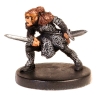
Hairfoot Rogue.
Getting Up to Speed
Our new player brought a character sheet for his 8th level Dragonborn Ranger from the game he plays with older kids. Alarm bells went off in my head, and I knew this would be a tougher session to run than last time. I took him aside and talked to him about how this game was different: different rules, no classes, and no dragonborn characters. I offered him the 4 pregens I had left, and he chose the Hairfoot Rogue.

I had him roll Thievery to gather rumors that he could pass on to the rest of the party, and to show him how the mechanics worked. I think he got the mechanics pretty quickly. My daughter wanted to name this session "The Haunted Church", so I gave him a rumor about a roadside church back toward civilization. People went in to pray and many times they didn't come out. We went back to join the rest of the party.
They skipped the church...

Decision Time
The party marched their orc prisoner back to town and handed him off to the magistrate. Yes, there were renewed calls of "kill the prisoner" on the way, and our new rogue decided to play to stereotype and try to loot and steal everything. Sometimes a little RPG experience is dangerous.

Everyone had a chance to reintroduce their characters. Everyone took the same characters they had last time, which avoided the "I want to play the archer this time!" discussion that I feared. Everyone's character slept and got mana and hit points back.

The joking and disruption kept going. There was confusion about who already knew each other. I explained (twice) that the rogue had been part of the pre-game adventure of killing the dragon, but he had been delayed in town and couldn't investigate the Haunted Guardpost with the rest of them. We got into a metagame discussion about where the rumor about the church came from. It was a struggle to keep everyone's attention, and the Rogue's "I want to rob the rich houses in town" refrain didn't help. It's a village. You're in the richest house in town; it's called the inn, and you're lucky it got two stars.

In the morning, the party saw the magistrate mount a horse and head east toward more civilized lands with his orc prisoner in tow. They also had a decision to make. I gave them the option of checking out the haunted church, or following up on the information the orc prisoner gave about the rest of the orc warband holing up in a cave a few hours' walk past the guardpost. Since they got it in their heads that the orcs may attack sooner rather than later, they chose to check out the warband.

The Approach
...and went for the cave with the orcs.
We went to the map and handwaved the travel time. They saw an orc guard in a stand of trees that masked the cave entrance, just off the road exactly where the orc prisoner had said. The rogue went off ahead, got the drop on the guard, questioned him at daggerpoint ("Wulgash leads here. We will destroy the town, and you will die!"), then slit his throat. Having Rogue 6, skill in Dagger, Interaction, and Thievery, and Exceptional Rogue makes ridiculous numbers much more common.

In looting the body, they only found an orcish sword, which they kept. They found no other guards outside, so they approached the cave entrance. The Druid checked for tracks and counted at least 20 orcs who have been here for at least 2 weeks. The Wizard cast Light on his staff so everyone would be able to see when they went in. The Rogue wanted to zip off ahead (and probably die), and he wanted the Wizard's staff so he could see.

The Rogue wanted to use his Interaction to talk the Wizard out of his staff. I wouldn't allow using a social ability against another PC, especially since the Wizard's player was out of the room at the time. I suggested asking the Wizard for his staff and seeing how that went. There was asking and pleading, then the Rogue got stuck on "stabbing the Wizard in the butt". Time to refocus away from that rathole, as everyone was talking too loudly to hear anyone else anyway.

The Archer looked into the cave with her Incredible Sight, and saw the tunnel take a left after about 30 feet. On the wall opposite the entrance, she saw a half dozen arrow slits. An arrow narrowly missed her, and suddenly all butt-stabbing was forgotten.

The Best Laid Plans End With "Get 'Em!"
How deep is your dungeon?
Everyone piled into the cave and started shooting at the arrow slits or running to the turn to get under cover. About half the party was hit with arrows. The Archer and the Rogue managed to get a dagger and arrow through the slits, but they didn't know how well they did. The Wizard rolled really well with a Firebolt, and the entrance filled with a lovely charred orc smell.

They turned the corner and saw that the tunnel took a right about 30 feet in. At the corner, there were 2 rough curtains covering a section of both walls. One of the boys came up with, "Maybe there's a naked lady behind the curtain!" and suddenly everybody wanted to get to the curtains. At this point I kept going around the table asking what everyone was doing, and fighting to keep everyone quiet until it was their turn. After everyone had their say, I moved all the minis and resolved everything at once. It worked fairly well, I think.

Unfortunately, there was a trap in the hallway. The floor dropped about a foot, and spikes flew out to catch the Warrior, Monk, and Rogue in the shins for a few points of damage each. All but the Rogue fell down - again the high Rogue score saves the day. Four orcs came out from behind one of the curtains, from what looked like a kitchen. They had aprons and meat cleavers and charged the trapped characters. Shouts came from around the corner and further down the tunnel.

The party recovered, and killed half the orcs in one round. Another half dozen came around the corner. The Rogue asked if he could loot the body. I said "Sure, but these two will get free attacks on you. Still want to do it?" He declined. The party heard horns sounding further down the tunnel, and more sounds of orcs arming for battle. The Druid feared his estimate of the number of orcs was woefully low.

The Better Part of Valor
The second dozen got the point across.
More orcs turned the corner the next round. Some loved it, yelling "Bring 'em on!" Some realized that there were another few dozen orcs coming around that corner. Some were curious what was behind the other curtain. I kept pulling out orc minis and putting them on the map. Cooler heads prevailed and the party decided to retreat.

The Rogue started thinking about making traps. I told him anything would take time, but he could improvise something. He ran outside the cave and looked for rocks above the cave mouth to hopefully cause some damage and deter pursuit when the orcs came streaming out of the cave.

The Archer took an orc body, still smouldering from the fatal Firebolt hit, dragged it over to the arrow slits and stuffed the corpse's arm into one. The smoke from the body gave the party some cover from the archers behind the wall. In my mind, that was the awesome play of the day, right there.

The Monk used Athletics and Acrobatics to flip over to the other curtain, take a look behind it (a storeroom full of questionable foodstuffs), and jump back to join the party on the way out the door. Everyone else executed a decent fighting withdrawl, giving the Rogue a few rounds to work.

Not quite this, but effective.
The party ran out of the cave, a couple dozen orcs hot on their heels. The Rogue tripped the rockfall, which didn't kill anyone but gave the pursuers pause. The Archer and Wizard dropped a couple before they charged through the trees and lost sight of the cave. The orcs started arguing about whether or not to give chase. The party ran their legs off and escaped.

Back in Dragonville
They made it back to town in the evening to lick their wounds and try to fence their orc sword. Woo. At this point, the game broke up. They were more interested in playing with each other than playing the game, so I let them go. I did mention that the magistrate came back to town that evening and offered the party the use of the guardpost if they wanted to fix it up. So next time, they have more choices about what to do.

Everyone was scattered, trying to be funny, not paying attention to the game, and definitely talking too loudly. They're young, I get that. It was a full moon, which may have had something to do with it. I didn't have as much fun as I did the first time. Keeping everyone on the same page and repeating everything a few times so everyone knew what was happening got old quickly.

I've got some more thoughts and reactions on this session, but I think I'll break those out into another post like I did last time.

Thanks for reading!

2013-01-24

Growing Up Gamer

The purple/blue d20 is her favorite.
Yes, she's in Fairy Form here.
I grew up a gamer. I played chess with my father until I fought him to a draw when I was about 10, then we never played again. I used to read his Games Magazines when he was done with the World's Most Ornery Crossword, and I got hooked on cryptograms. In 5th grade we played board games at school sometimes, and they gave me Stratego and Careers to keep at the end of the year. I still have them.

I got my first D&D Basic set (Moldvay - now available in PDF!) in 1981, and a multiverse of possibilities opened up. RPGs gave me a structure around which to build worlds, and to tell stories in those worlds. Sometimes the story came first and begged for a world, sometimes the world spawned stories on its own. In any case, the creativity genie had escaped the bottle, never to return.

And now, I'm a father. I have an intelligent and precocious daughter, who sketches books and designs outfits and willfully has trouble listening sometimes. We build robots and play chess and read stories.

And we game.

It started with Princess Ruth when she was 4, which was an interactive bedtime story. We still have some of the story yet to go, since she still has to find the Dark Cave to destroy the Heart of Darkness. She told the story. I just provided details and challenged her occasionally with NPC reactions and information from her research.

Recently, we've moved on to actual RPG play with her and her friends. I chose to go with Warrior, Rogue & Mage, since task resolution requires rolling a d6 and adding a modifier to beat a target number. I went into the first game with very little prep, and we all had a grand old time. I need to limit handing out Luck Points, since getting 2 6s in a row seems fairly easy. Maybe 3 6s in a row instead? Take a look at other lessons learned from the first game, if you're so inclined.

All diced up and ready to roll.
Santa got her a pack of 4 Hello Critty dice in her stocking. Last week we went to our FLGS The Whiz to pick up a full set of dice and a starter dice bag. She picked through and got different colors that she liked, and now she has dice that are all hers. She's outfitted and ready to go for the next game on Saturday. She's excited. Her friends are excited. Hell, I'm excited.

I've started a Game & Potluck Night on the second Saturday of the month at my church. We had over 50 people come out for the first event in January. I hope to do at least that well for the next Game & Potluck Night in March. Eventually we'll put out a tip hat and see if anyone wants to chip in for new games. And we may have a table for RPGs before long. We'll see what the market will bear.

That's the glory of gaming. It's discovering something new to pique the interest. It's allowing everyone at the table to create or change the world or story in some way so everyone is invested in the game. It's keeping everyone coming back for more to build on the pieces they've invested in. It's sharing a table with people you like and making memories that get better with every retelling.

I hope to infect future generations with the gaming bug.

I think I'm doing fairly well so far.

2012-12-07

Teach Your Kids to Game Week

We're smack dab in the middle of this year's Teach Your Kids to Game Week, which runs December 3-10, 2012. I'm not sure a week is enough, since I think we should teach gaming whenever we can, but it might jog a few parents into action who otherwise wouldn't think of it.

Why Teach Gaming?
My wife recently shared an article listing the Top 10 Skills Children Learn from the Arts. When I read it, I realized that the same list neatly covers skills learned from Gaming as well. Patience, focus, creative problem-solving, perseverance - all of these spring just as easily from the gaming table.

I think Fitz's article about Cultivating a Beginner's Mind over at Game Knight Reviews hits another benefit squarely on the head. When you teach, a part of you recalls the limitless possibilities you had when you first learned. Before the limits and even defining what "failure" was in a gaming sense, you were free to explore and define your reality without fear. You were p'u, the uncarved block who had no preconceived limits on what was possible, and a piece of that mindset rekindles when you play RPGs and other games with your kids. I don't know about you, but tapping into that feeling helps keep me young.

Communication Is Key
In my mind, RPGs teach communication skills most of all. I've never heard anyone request less communication, unless they're trying to limit spam messages. But limiting face to face communications? I've only heard pleas for brevity, not less communication.

"It looks just like the GM described it!"
RPGs center around communication. It's a game where you create a new reality out of nothing but words: describing locations and items and actions and speaking in character. More thoughts on this in an upcoming post, so stay tuned.

No matter what work you or your kids end up doing in life, role playing games train communication skills and make habitual players more more rounded people, and thus more valuable workers. RPGs encourage speaking up around the table. They encourage taking action and describing that action in a way that everyone else around the table understands. Players come up with unorthodox ideas to solve problems. Players learn how to look at a situation from differing viewpoints and prioritize what to do next. Persevering through a quest rewards you with loot or character improvement. RPGs encourage working in a group and finding ways to get along with others to accomplish goals.

Do I sound like a business-based motivational speaker yet?

How Do I Start?
Don't overwhelm your kids with rules. Telling the story and controlling a character are key to getting kids jazzed about RPGs. I suggest using something lightweight, like RPG Kids or Argyle & Crew. I know people playing with something as light as the Clay-O-Rama rules from Dragon Magazine #125, and as crunchy as straight AD&D, so whatever rules you're comfortable with can work for kids, if you can explain them in small enough chunks for everyone at the table to understand. Or you can take all the math bits behind the GM screen and just have your younger players roll dice and decide what their character does next.

Drive Thru RPG has some other suggestions for RPGs for kids. And they're promoting Teach Your Kids to Game Week with resources like this banner:

DriveThruRPG.com

I'm using Warrior, Rogue & Mage in my RPG for kids since it's all d6+bonus vs. target number. I've posted some lessons learned from my first RPG for kids run which you may find helpful. I'm also excited to get my hands on Sidekick Quests when the rules are released. Definitely read the Sidekick Quests webcomic if you haven't yet. James Stowe's character sheets and monster sheets are very accessible and irrepressibly fun.

What Am I Doing This Week?
Sadly, not much, though I've talked with my daughter about finishing up the story of Princess Ruth that we've been creating occasionally at bedtime. I'm flat out between work and homeschool and cleaning and being dad and shopping and adjusting to 2 new cats and getting back to writing The Tao of Gaming. But I am scheduling the next RPG for kids session for January or February. I can't wait to see what happens in Dragonville next.

Game on. And involve your kids this time.

2012-10-29

Kids RPG: Lessons Learned and Ideas for Next Time

I had many things work well and a few things work not as well in the Kids RPG. Consider this post as notes to myself for next game, though if you get inspired to use something here for your game, I won't stop you.

1) Doing Something Trumps Explaining Anything
This is a no-brainer, but it came back to me loud and clear as we started. Explaining how to hit someone is boring. Rolling to torch an ogre with a fire bolt, even if you have no idea how to do it, is exciting. Which one will kids talk about between now and the next game?

2) Make Simpler Character Sheets
What I had would be appropriate for adult gamers, but the skill list got in the way. So I'll remove them and keep just the relevant trained skills for next time. If I can fit characters on 3x5 cards, I'll do that. The less there is to look at, the better off we'll all be.

3) Prepare, But Be Flexible
Now that they know they can control the world with Luck Points, I expect there will be a run on spending Luck Points next game. I'll need enough structure to get them oriented, since they immediately ran amok with the village name and deciding what to do next, but I'll need to be able to change anything at the drop of a Luck Point.

4) Use Glass Beads As Luck Point Tokens
I found a stash of glass beads that I picked up years ago at a yard sale. I washed them and picked out the mirror-finish ones to use as Luck Points. This gave everyone the visceral feel of receiving something when their die exploded twice, and of spending something when making changes to the story. I will do this again, though I may need more beads if I have a full table.

5) Stay Flexible With Initiative
I had visions of using the Marvel "act, then decide who goes next" initiative system. I'm not sure they're ready for that yet, so I'll keep with going around and getting everyone's move, then ordering it as logically as possible, rolling dice to break ties. It seemed to work fairly well last time without too many interruptions, so we'll stick with next time.

6) Let Them Think Fairly
I may have overstepped my purview as GM last time a couple of times, but then again I'm dealing with 6-8 year olds. I stepped in when one of the youngest players wanted to kill the orc that surrendered, and I suggested that they take him back to the village to face justice. I also gave some structure to the treasure division process. They were tired after 2 hours of gaming, so I can understand things getting a little heated while divvying loot. I kept asking, "Do you think that's fair?" and I think they caught on after the first few times. Part of me wants to step back and let them sort it out, but part of me fears a Lord of the Flies solution which wouldn't be good for anyone. I'll keep an eye on myself in these situations and make the best calls I can.

7) Don't Make It Too Easy
Yes, I fudged exactly once. I didn't want to kill my daughter's character during the second round of combat, so I'll plead guilty to that one. Once that luck point was spent to give the orcs clubs instead of swords (losing the +2 for skill and a point of base damage), the combat really turned in the party's favor. I'll need to get a little creative with challenges for next time. This adventure was a complete muckle in 3 acts, and I think that worked for a first adventure. I'll need to ride the Wizard's player to keep track of Mana spent, letting him decide between flashy and pragmatic. There's more to balance here, so suffice to say I'll try some new approaches next time to challenge them, and maybe work a little more toward non-combat intrigue.

Anything you've discovered that you can add to this list?

Plugging a Couple of Lightweight RPGs

I just wanted to get out a couple of quick plugs for those of you looking for lightweight RPGs. I hear there's some call for them. There are several out there to choose from, but I've had my head in these two systems quite a bit lately.

1. Warrior, Rogue & Mage
I just completed the first in what I hope to be a series of RPG Sessions for Kids. For the rules, I used Warrior, Rogue & Mage. I hacked WyRM a bit, adding multiple levels of skills, the +5 instead of +6 for an exploding die, and the damage rules from Resolute, Adventurer & Genius (pulp action WyRM, and definitely worth a look if you're into that genre). I changed some of the skills and weapons, adding a little variety to both. I hacked the fantasy racial bonuses and changed them into a pick list of advantages and disadvantages. I think that'll add some flexibility in character creation.

I extended the talent list quite a bit. I dug up the old idea of a Summoner, a spellcaster who can do nothing but summon imps and sprites to do his bidding, so I added that idea in. I've always loved the idea of spells being cast through weapons as part of an attack, so I added the Mageblade talent. I added the Shield Expert and Shield Master talents, and I added Weak Attributes, for when your character is really, not even a little bit, really not a Warrior.

The system is Attribute + Skill + 1d6 compared with a target number. The exploding dice (top-ending rolls of 6) makes life interesting and tremendously unpredictable. The three title attributes lets me scribble down usable stats for a mook in 2 lines and an NPC in 3. I had a reference sheet all printed out for my first run, but the system was so intuitive that I never even looked at it during play.

If you're interested, grab a copy of the published rules from the links above. You can also download my Excel 2007 WyRM reference sheet with all my hacks that I pulled together for quick reference during play. I didn't do anything for spells, but I'll either add that as a separate sheet or cram it in with Equipment. I printed the reference sheet landscape 2-up and 2-sided so it fits on one piece of Letter-sized paper, but your mileage may vary. You can also download the blank character sheet I made (you'll need the Hingham Text font and Excel 07), and the pre-generated characters I made (10 of them).

2. BareBones Fantasy
I got hired as the editor for BareBones Fantasy a few months back. There have been many revisions along the way, but the finished system just released this morning on DriveThruRPG. I may be biased, but I think it gives you everything you could ask for in an RPG: solid rules, great systems to fiddle with, a sketch of a setting to build on, and good-looking art throughout.

It's percentile-based system, where you roll under your attribute or skill to succeed. It's very much like the Chaosium Call of Cthulhu rules, but with only 7 very broad skills. Anything not covered by a skill goes against one of the 4 attributes in the same manner. Critical success or failure happens on doubles, which I think is an elegant way to factor skill into the crit equation.

There's a short spell list, but each entry pares down the spell to its base function. It's up to the caster and the GM to give each spell the effects and character to bring it to life. For example, Offensive Strike lets you cause damage, but you get to decide if it's a fireball, or falling rocks, or a summoned swarm of locusts with razor-sharp legs.

The random generation section really stands out. There are tables for adventure ideas encompassing objectives and obstacles for each scene (recover the maguffin and save the princess while bringing the guilty to justice before time runs out, for example), random dungeon maps (take that, AD&D DMG!), traps, creatures, treasure, and non-standard adventure rewards. These systems and tables provide a pile of ideas and little bits you can inject into any fantasy game. To me, those 10 pages alone are worth the price, and you get the rest of the system for free!

Both rule systems are really easy to internalize so you're not looking things up every 5 minutes, and neither suffers from supplement creep. BBF is designed as a single-volume ruleset, so I don't think too much will be added outside of setting description and adventures. WyRM does have a handful of short supplements to extend the rules with options, but they're not needed at all. People are hacking WyRM into their own self-contained system books, and I can't wait to read the SF-flavored hack when it comes out.

So if you're in the market for light fantasy RPGs, I suggest you look at these two systems.

The Story of the Haunted Guard Post

On Sunday, I ran a roleplaying game for 4 kids, aged 6-8 years. And it rocked the house.

I've been planning this for a while - we started scheduling this in the summer. I was looking for a lightweight ruleset and toyed with a few systems before settling on Warrior, Rogue & Mage. Truth be told, I hacked WyRM a bit, but I think the rules came together. If you're interested, download my Excel 2007 WyRM reference sheet (I printed it landscape 2-up and 2-sided so it fits on one piece of Letter-sized paper), the blank character sheet I made (you'll need the Hingham Text font), and the pre-generated characters (10 of them). I chickened out and didn't offer the Hairfoot Summoner, but I had visions of that magic system being very cool and flexible.

Their version was nowhere near this.
Theirs was cooler, hacked from the
Lego Ramses Return game.
Starting Up
My daughter and her friends are very independent, so they started hacking together their own version of Lego D&D before we even started. I let them go until they were good and ready to sit down and play. I set out 9 minis and gave a brief overview of each, then let them choose one to play. We had a Human Monk, a Human Druid, an Elf Wizard, a Dwarf Warrior, and a Human Archer. No disputes; so far, so good.

I handed out the character sheets based on their choices and gave a 5-minute crash course of the rules and where to find things on the sheet. Even five minutes was too long, so I dove in to getting a sketch of party history. Everyone shrugged when I asked how the characters knew each other, though "Because the players are friends" made me laugh. We eventually decided that they had just finished an adventure defeating a dragon in a cave, which was very similar to an impromptu game of Hero Quest I ran a couple of weeks back.

I wanted their input on the town, so we spent some time coming up with ideas. Since the party had just defeated a dragon and saved the town, we decided on Dragonville. The party was staying in town because the townsfolk were holding a feast in their honor.

If you're interested,
grab your own copy.
Introducing the System
Since the quick overview didn't really take, I thought I'd give them a quick taste of what a roll looked like. I decided that contests of skill were part of the feast, so there was an archery contest, a wrestling contest, and a spellcasting contest. I had everyone choose their strong suit to compete in, and give me a roll. The 1d6+stat+skill system worked fairly well. I made it as easy as I could by recording the stat+skill as a single bonus, but doing the math took some kids longer than others. When the Dwarf Warrior (Warrior 6) and the Monk (Warrior 5 +2 Unarmed) wrestled each other and the Dwarf's die exploded, it took a minute to verify the 12 vs. 15 result.

Setting the Hook
The day after the feast, the characters were talking about what to do next over breakfast. They were thinking about going back to the cave and looking for dragon eggs to destroy, when a farmer burst in. He sounded delirious, saying "The guard post is haunted!" before collapsing from an arrow wound. The Druid revived the farmer as the Wizard examined the arrow, which looked Orcish. The farmer got too close to the abandoned guard post when catching a stray cow, and a voice threatened him to stay away. Some bodies near the guard post stood up and started chasing him. He was so scared, he just ran. He passed out a couple of times, but ran directly to Dragonville for help. The characters left for the hilltop guard post immediately.

This was a great time for a quick break to get more food.

Not quite like this. Our
guard tower was round.
Action!
The party arrived at the hilltop guard post. They saw a short tower next to a stable and another building, with dead bodies lying around the tower. When they started talking about what to do next, an eerie voice called out "Come no further unless you bring money." Between a lack of Incredible Hearing talents and abysmal Awareness rolls, everybody was wondering which dead body said that. After some bickering, the voice said, "Then suffer!" and seven bodies stood up, shambling toward the characters.

Throwing axes, arrows, and Fire Bolts streaked across the sky, and the Monk and Warrior dove into the fray. The Monk kicked off Ironskin, which held death at bay as the skeletons and zombies slammed him down to 1 HP in a single round. Then the sharp-eyed Archer caught an ogre trying to sneak around the stable to flank the party. The Wizard and Archer opened fire as the Druid cast Startle on him. Next round, the Wizard dropped him with a Fire Bolt.

The party was starting to mop up the undead, when they noticed a team of orcs coming out of the tower. The Warrior's player decided to spend a Luck Point to change a detail of the story. Since he couldn't make the orcs disappear, he made them not have swords. I gave them clubs instead, but he basically traded a luck point to drop their attacks by 2 points. Was that luck point too powerful? Maybe, but it sparked the idea in the rest of the group that Luck Points could do some funky things. That level of inspiration and engagement is worth a great deal more than a Luck Point, so I wholeheartedly allowed it.

Since the orcs were so nerfed by their lack of swords, and since the Wizard dropped the Orc Cleric in a single shot, the 3 that were left made a run for it. Then the 1 that was still standing surrendered. There were calls to kill him, but only from the youngest. I offered that there were law enforcement people to take charge of the orcs back in Dragonville, and cooler heads rallied around that idea.

Like this, only glowing.
Aftermath
The Archer with her Interaction skill questioned the remaining conscious orc and found that the stairs in the tower were trapped. She also found that the orcs were an advance scout for a larger warband and got directions to that base of operations.

In exploring the tower and stripping magic items from the fallen, the party came up with 150sp, a red spinel gem (probably 150sp), a glowing magic sword, a magic chain shirt made of extremely fine links, a potion of healing (defined by another use of Luck Points), and a ring of defense. Everyone wanted the ring. Uh-oh. I pointed out that there was enough for everyone to get something, and nobody should get more than one thing until everyone had something cool. I started going down the list, and everyone negotiated well for what they wanted.

And with that, we were out of time and off to run to a family dinner. Busy weekend was busy. Sometime soon I'll start scheduling the next game. We'll see if everyone wants to keep the same characters.

More thoughts forthcoming in a Lessons Learned and Ideas for Next Time post.