2012-11-02

[NaGaDeMon] Trainstorming

I took a look at the Birthright board game rules this morning. Not much there, as it's more focused on Regent characters and beating up everyone else. I'm shooting for more of a domain management game with a stronger focus on building each region.

Decisions: This will be a straight board game with hooks to use it in RPGs, not an add-on system to an RPG. Hopefully the game itself will work that way one I'm done.

Looking for ways to denote strength in a few categories on a hex space. Thinking of different-colored dice in d4 through d12. Elegant, and it lets you pick up dice from a hex and roll. Expensive to produce, so maybe tokens instead if this ever goes to production.

Also need a way to look at foreign influence by category in a hex. Tokens to sit the die on would work. May need to limit to one foreign influence per category for sanity, but we'll see how it plays out.

I'm getting some rules gelling in my head. Very cool. Will write them soon and start revising from there.

To get: sets of cheap dice. I may pass on the water hexes for now and trust the layout creativity of the players to make non-clumpy land masses and assume gaps are filled with water, either salt or fresh.

Still mucking with economy in my head, though the military mechanics may inform that.

What constitutes ownership of a hex? I want to allow conversion and economic takeover as well...

2012-10-31

[NaGaDeMon] Post Zero.

There's a place and a time when the journey begins. Here is that place. Now is that time.

I just posted over at NaGaDeMon's 2012 Roll Call. So simple an act, but so big in meaning. I'm going to design and play a game in November. And you're invited to watch, cheer, provide feedback, and eventually play.

I'm going to move The Domain Game beyond the confines of vague system-like posts on the blog and into an actual system. It may not do everything I want out of the gate, and it may not even have the same province stats, but it will be workable and, more importantly, it will be done. And it will use Settlers of Catan terrain hexes.

Speaking of which, does anyone have any water hexes I could abscond with? Or at least any cheap sources of them? I'd rather not invest in Seafarers at retail just to cannibalize the water tiles.

2012-10-29

Kids RPG: Lessons Learned and Ideas for Next Time

I had many things work well and a few things work not as well in the Kids RPG. Consider this post as notes to myself for next game, though if you get inspired to use something here for your game, I won't stop you.

1) Doing Something Trumps Explaining Anything
This is a no-brainer, but it came back to me loud and clear as we started. Explaining how to hit someone is boring. Rolling to torch an ogre with a fire bolt, even if you have no idea how to do it, is exciting. Which one will kids talk about between now and the next game?

2) Make Simpler Character Sheets
What I had would be appropriate for adult gamers, but the skill list got in the way. So I'll remove them and keep just the relevant trained skills for next time. If I can fit characters on 3x5 cards, I'll do that. The less there is to look at, the better off we'll all be.

3) Prepare, But Be Flexible
Now that they know they can control the world with Luck Points, I expect there will be a run on spending Luck Points next game. I'll need enough structure to get them oriented, since they immediately ran amok with the village name and deciding what to do next, but I'll need to be able to change anything at the drop of a Luck Point.

4) Use Glass Beads As Luck Point Tokens
I found a stash of glass beads that I picked up years ago at a yard sale. I washed them and picked out the mirror-finish ones to use as Luck Points. This gave everyone the visceral feel of receiving something when their die exploded twice, and of spending something when making changes to the story. I will do this again, though I may need more beads if I have a full table.

5) Stay Flexible With Initiative
I had visions of using the Marvel "act, then decide who goes next" initiative system. I'm not sure they're ready for that yet, so I'll keep with going around and getting everyone's move, then ordering it as logically as possible, rolling dice to break ties. It seemed to work fairly well last time without too many interruptions, so we'll stick with next time.

6) Let Them Think Fairly
I may have overstepped my purview as GM last time a couple of times, but then again I'm dealing with 6-8 year olds. I stepped in when one of the youngest players wanted to kill the orc that surrendered, and I suggested that they take him back to the village to face justice. I also gave some structure to the treasure division process. They were tired after 2 hours of gaming, so I can understand things getting a little heated while divvying loot. I kept asking, "Do you think that's fair?" and I think they caught on after the first few times. Part of me wants to step back and let them sort it out, but part of me fears a Lord of the Flies solution which wouldn't be good for anyone. I'll keep an eye on myself in these situations and make the best calls I can.

7) Don't Make It Too Easy
Yes, I fudged exactly once. I didn't want to kill my daughter's character during the second round of combat, so I'll plead guilty to that one. Once that luck point was spent to give the orcs clubs instead of swords (losing the +2 for skill and a point of base damage), the combat really turned in the party's favor. I'll need to get a little creative with challenges for next time. This adventure was a complete muckle in 3 acts, and I think that worked for a first adventure. I'll need to ride the Wizard's player to keep track of Mana spent, letting him decide between flashy and pragmatic. There's more to balance here, so suffice to say I'll try some new approaches next time to challenge them, and maybe work a little more toward non-combat intrigue.

Anything you've discovered that you can add to this list?

Plugging a Couple of Lightweight RPGs

I just wanted to get out a couple of quick plugs for those of you looking for lightweight RPGs. I hear there's some call for them. There are several out there to choose from, but I've had my head in these two systems quite a bit lately.

1. Warrior, Rogue & Mage
I just completed the first in what I hope to be a series of RPG Sessions for Kids. For the rules, I used Warrior, Rogue & Mage. I hacked WyRM a bit, adding multiple levels of skills, the +5 instead of +6 for an exploding die, and the damage rules from Resolute, Adventurer & Genius (pulp action WyRM, and definitely worth a look if you're into that genre). I changed some of the skills and weapons, adding a little variety to both. I hacked the fantasy racial bonuses and changed them into a pick list of advantages and disadvantages. I think that'll add some flexibility in character creation.

I extended the talent list quite a bit. I dug up the old idea of a Summoner, a spellcaster who can do nothing but summon imps and sprites to do his bidding, so I added that idea in. I've always loved the idea of spells being cast through weapons as part of an attack, so I added the Mageblade talent. I added the Shield Expert and Shield Master talents, and I added Weak Attributes, for when your character is really, not even a little bit, really not a Warrior.

The system is Attribute + Skill + 1d6 compared with a target number. The exploding dice (top-ending rolls of 6) makes life interesting and tremendously unpredictable. The three title attributes lets me scribble down usable stats for a mook in 2 lines and an NPC in 3. I had a reference sheet all printed out for my first run, but the system was so intuitive that I never even looked at it during play.

If you're interested, grab a copy of the published rules from the links above. You can also download my Excel 2007 WyRM reference sheet with all my hacks that I pulled together for quick reference during play. I didn't do anything for spells, but I'll either add that as a separate sheet or cram it in with Equipment. I printed the reference sheet landscape 2-up and 2-sided so it fits on one piece of Letter-sized paper, but your mileage may vary. You can also download the blank character sheet I made (you'll need the Hingham Text font and Excel 07), and the pre-generated characters I made (10 of them).

2. BareBones Fantasy
I got hired as the editor for BareBones Fantasy a few months back. There have been many revisions along the way, but the finished system just released this morning on DriveThruRPG. I may be biased, but I think it gives you everything you could ask for in an RPG: solid rules, great systems to fiddle with, a sketch of a setting to build on, and good-looking art throughout.

It's percentile-based system, where you roll under your attribute or skill to succeed. It's very much like the Chaosium Call of Cthulhu rules, but with only 7 very broad skills. Anything not covered by a skill goes against one of the 4 attributes in the same manner. Critical success or failure happens on doubles, which I think is an elegant way to factor skill into the crit equation.

There's a short spell list, but each entry pares down the spell to its base function. It's up to the caster and the GM to give each spell the effects and character to bring it to life. For example, Offensive Strike lets you cause damage, but you get to decide if it's a fireball, or falling rocks, or a summoned swarm of locusts with razor-sharp legs.

The random generation section really stands out. There are tables for adventure ideas encompassing objectives and obstacles for each scene (recover the maguffin and save the princess while bringing the guilty to justice before time runs out, for example), random dungeon maps (take that, AD&D DMG!), traps, creatures, treasure, and non-standard adventure rewards. These systems and tables provide a pile of ideas and little bits you can inject into any fantasy game. To me, those 10 pages alone are worth the price, and you get the rest of the system for free!

Both rule systems are really easy to internalize so you're not looking things up every 5 minutes, and neither suffers from supplement creep. BBF is designed as a single-volume ruleset, so I don't think too much will be added outside of setting description and adventures. WyRM does have a handful of short supplements to extend the rules with options, but they're not needed at all. People are hacking WyRM into their own self-contained system books, and I can't wait to read the SF-flavored hack when it comes out.

So if you're in the market for light fantasy RPGs, I suggest you look at these two systems.

The Story of the Haunted Guard Post

On Sunday, I ran a roleplaying game for 4 kids, aged 6-8 years. And it rocked the house.

I've been planning this for a while - we started scheduling this in the summer. I was looking for a lightweight ruleset and toyed with a few systems before settling on Warrior, Rogue & Mage. Truth be told, I hacked WyRM a bit, but I think the rules came together. If you're interested, download my Excel 2007 WyRM reference sheet (I printed it landscape 2-up and 2-sided so it fits on one piece of Letter-sized paper), the blank character sheet I made (you'll need the Hingham Text font), and the pre-generated characters (10 of them). I chickened out and didn't offer the Hairfoot Summoner, but I had visions of that magic system being very cool and flexible.

Their version was nowhere near this.
Theirs was cooler, hacked from the
Lego Ramses Return game.
Starting Up
My daughter and her friends are very independent, so they started hacking together their own version of Lego D&D before we even started. I let them go until they were good and ready to sit down and play. I set out 9 minis and gave a brief overview of each, then let them choose one to play. We had a Human Monk, a Human Druid, an Elf Wizard, a Dwarf Warrior, and a Human Archer. No disputes; so far, so good.

I handed out the character sheets based on their choices and gave a 5-minute crash course of the rules and where to find things on the sheet. Even five minutes was too long, so I dove in to getting a sketch of party history. Everyone shrugged when I asked how the characters knew each other, though "Because the players are friends" made me laugh. We eventually decided that they had just finished an adventure defeating a dragon in a cave, which was very similar to an impromptu game of Hero Quest I ran a couple of weeks back.

I wanted their input on the town, so we spent some time coming up with ideas. Since the party had just defeated a dragon and saved the town, we decided on Dragonville. The party was staying in town because the townsfolk were holding a feast in their honor.

If you're interested,
grab your own copy.
Introducing the System
Since the quick overview didn't really take, I thought I'd give them a quick taste of what a roll looked like. I decided that contests of skill were part of the feast, so there was an archery contest, a wrestling contest, and a spellcasting contest. I had everyone choose their strong suit to compete in, and give me a roll. The 1d6+stat+skill system worked fairly well. I made it as easy as I could by recording the stat+skill as a single bonus, but doing the math took some kids longer than others. When the Dwarf Warrior (Warrior 6) and the Monk (Warrior 5 +2 Unarmed) wrestled each other and the Dwarf's die exploded, it took a minute to verify the 12 vs. 15 result.

Setting the Hook
The day after the feast, the characters were talking about what to do next over breakfast. They were thinking about going back to the cave and looking for dragon eggs to destroy, when a farmer burst in. He sounded delirious, saying "The guard post is haunted!" before collapsing from an arrow wound. The Druid revived the farmer as the Wizard examined the arrow, which looked Orcish. The farmer got too close to the abandoned guard post when catching a stray cow, and a voice threatened him to stay away. Some bodies near the guard post stood up and started chasing him. He was so scared, he just ran. He passed out a couple of times, but ran directly to Dragonville for help. The characters left for the hilltop guard post immediately.

This was a great time for a quick break to get more food.

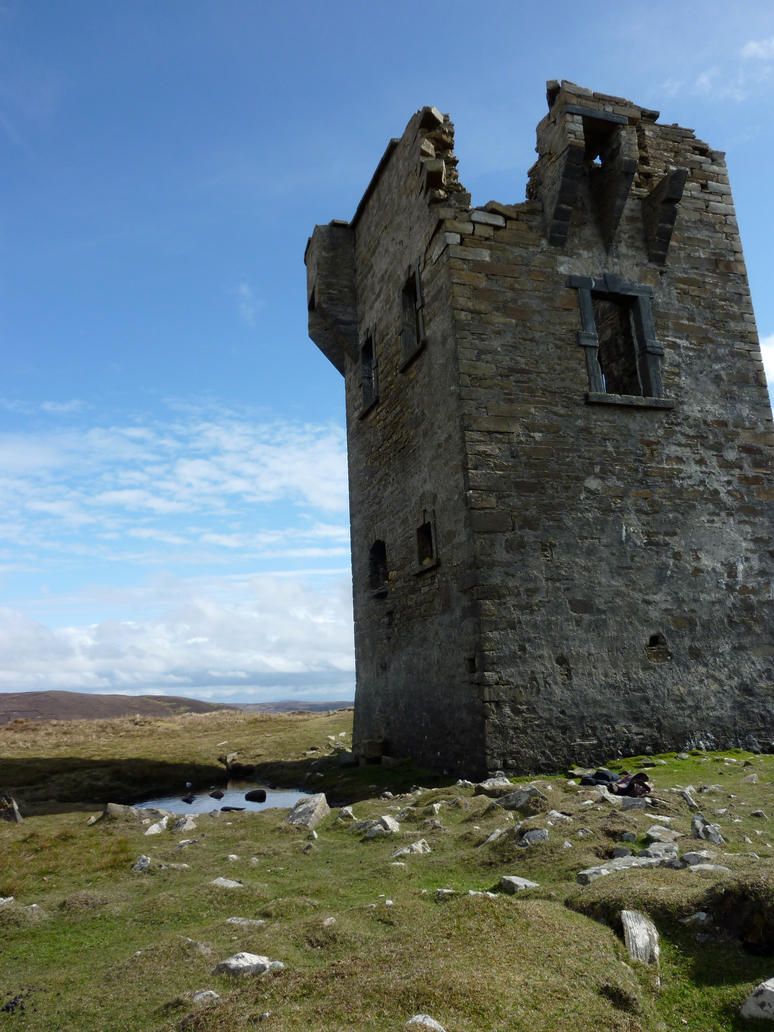
Not quite like this. Our
guard tower was round.
Action!
The party arrived at the hilltop guard post. They saw a short tower next to a stable and another building, with dead bodies lying around the tower. When they started talking about what to do next, an eerie voice called out "Come no further unless you bring money." Between a lack of Incredible Hearing talents and abysmal Awareness rolls, everybody was wondering which dead body said that. After some bickering, the voice said, "Then suffer!" and seven bodies stood up, shambling toward the characters.

Throwing axes, arrows, and Fire Bolts streaked across the sky, and the Monk and Warrior dove into the fray. The Monk kicked off Ironskin, which held death at bay as the skeletons and zombies slammed him down to 1 HP in a single round. Then the sharp-eyed Archer caught an ogre trying to sneak around the stable to flank the party. The Wizard and Archer opened fire as the Druid cast Startle on him. Next round, the Wizard dropped him with a Fire Bolt.

The party was starting to mop up the undead, when they noticed a team of orcs coming out of the tower. The Warrior's player decided to spend a Luck Point to change a detail of the story. Since he couldn't make the orcs disappear, he made them not have swords. I gave them clubs instead, but he basically traded a luck point to drop their attacks by 2 points. Was that luck point too powerful? Maybe, but it sparked the idea in the rest of the group that Luck Points could do some funky things. That level of inspiration and engagement is worth a great deal more than a Luck Point, so I wholeheartedly allowed it.

Since the orcs were so nerfed by their lack of swords, and since the Wizard dropped the Orc Cleric in a single shot, the 3 that were left made a run for it. Then the 1 that was still standing surrendered. There were calls to kill him, but only from the youngest. I offered that there were law enforcement people to take charge of the orcs back in Dragonville, and cooler heads rallied around that idea.

Like this, only glowing.
Aftermath
The Archer with her Interaction skill questioned the remaining conscious orc and found that the stairs in the tower were trapped. She also found that the orcs were an advance scout for a larger warband and got directions to that base of operations.

In exploring the tower and stripping magic items from the fallen, the party came up with 150sp, a red spinel gem (probably 150sp), a glowing magic sword, a magic chain shirt made of extremely fine links, a potion of healing (defined by another use of Luck Points), and a ring of defense. Everyone wanted the ring. Uh-oh. I pointed out that there was enough for everyone to get something, and nobody should get more than one thing until everyone had something cool. I started going down the list, and everyone negotiated well for what they wanted.

And with that, we were out of time and off to run to a family dinner. Busy weekend was busy. Sometime soon I'll start scheduling the next game. We'll see if everyone wants to keep the same characters.

More thoughts forthcoming in a Lessons Learned and Ideas for Next Time post.