Showing posts with label gaming. Show all posts

2025-09-07

Rambling For My 56th

56th Operations Support Squadron
Effin' WIZARDS, Man.

So today I've officially survived 56 orbits of our local star, which means I've been playing RPGs for over 44 years now.

Why?

Because they're fun. Because I can become someone I'm not and walk a while in their shoes. Because I enjoy building worlds and societies and finding the edges of what I know about how everything works. Because controlling fictional powers beyond the ken of mortals gives me hope.

Why did I choose choose the image of a patch for the 56th Operations Support Squad? Because Wizards. It spoke to me. And I'm sticking with it.

Today I write to find out.

Yes, I've watched the clip from this bsky post and read through the blog post talking with Paul Czege about The Ink That Bleeds. And I'm writing. So let's suspend our rationality and see where this goes.

2025-08-28

Two Decades??

TDK tape head cleaner cassette "HCL-11"
De-Gunking My Head Again.

I saw someone post that they've been blogging for years, so I thought I'd check the history here at the Gaming Den of Iniquity. And I took a step back.

Twenty Years? And almost a month.

But TWENTY Years?

Twenty Years Ago

On 29 July 2005, a Friday, I had a 2-month-old at home. (EDIT: I did not, in fact, have a 2-month-old at home. I barely remember this morning's breakfast, never mind 20 years ago. Details blur. But I still needed a gaming outlet.) I was self-employed, looking for contract gigs to pay the mortgage. My steady, 10-year-old D&D 3.5E game was going on permanent hiatus, because most of the group had newborns at home and thus higher priorities than gaming. I needed a game-oriented outlet.

So I started a blog. This one, right here. Go check the first two posts. I'll wait.

2014-01-09

A Disney Approach to RPG Experiences

While I was in Orlando over Thanksgiving, I scribbled some notes about how my experience at Disney might apply to running RPGs. Storylines and adventures aside, since I'm sure we already mine fairy tales for story elements, noticing the experience of a Disney theme park made me think about how we as tabletop RPG players and GMs can improve the craft of running games.
"You've got at least
10 levels of dungeon
under that thing..."

Welcoming
Every Disney cast member made sure we had a great time. It was their prime directive, above and beyond their job description, with the possible exception of the guy playing Aladdin who was a fabulous snarky bitch, which entertained me to no end. If we ever looked lost, a cast member approached from less than 10 feet away to ask if they could help. We felt safe and well cared for the entire time. It felt like coming home to a place I'd never been before.

How can we invite more players to our tables beyond simply using "Yes, and..." when dealing with players outside of the game session?

Immediate Feedback
A group of teens ducked under the chain and cut us off in line. A cast member immediately held them back and let us and another family past them, explaining that the chains were there for a reason. You can't get away with much at Disney. There are rules for the good of all, rigorously enforced.

How can we encourage the behaviors we want at the table and discourage behavior that makes others uncomfortable? Is an explicit social contract discussion enough, or do you need a way to safely communicate your discomfort during play (an X Card or safeword)?

"One ringy-dingy..."
Communication
Between the wait times clearly posted at every ride or event, to the mobile app also listing the wait times, to the quick answers to any question, to the frequent announcements whenever there was any problem with the ride, I can't think of a single improvement to Disney's communications. At times we suffered from an overabundance of information, especially the often-repeated announcements during the very few times when a ride stopped temporarily.

Since miscommunication causes frustration, how can we communicate with each other more effectively, both as players and GMs?

Efficiency
For every ride with a wait time posted, we always ended up waiting for less time than posted. Cast members made sure that people churned through the ride at a blinding pace, fixing problems and smoothing out the traffic flow. When buying food, a cast member acted as traffic cop to make sure we got into the shortest line. Longer lines for rides had mini-games and distractions set up so the wait rarely felt like simply waiting. The design of the rides and the cast members removed distractions and allowed us to focus on the star: the ride itself.

How can we limit the distractions of the rules and the outside world to focus everyone's attention on the game? And how can we do this consistently?

"Good grouping."
Found at despair.com.
Consistency of Experience
The whole attraction of Disney rests on everyone having the exact same experience on each ride every time. You can say "I rode the Buzz Lightyear ride at Disney," and everyone who has ever ridden will be right there in the seat beside you as you describe your experience.

RPGs have a hard time with this by design, since they're predicated on letting everyone at the table control the story and the action. Running the exact same scenario at a con for different groups of people will produce wildly varied outcomes. Some think that more specific rules will help enforce consistency, but we can't mandate how a person reacts to the rules in play. Some people may get fed up with the rules and look for a lighter game to play. People play RPGs for different reasons and find different areas that they call "fun".

Should we even try to reconcile this behavior in a quest for more "consistent fun" in our RPGs? Or would that undermine the Tabletop RPG experience, turning it into more of a closed-world computerized RPG?

Sadly, most ride scents were this...
Immersion
Most Disney rides already engage vision and hearing. Disney makes sure they engage touch, like the dark waterfall in Pirates of the Caribbean, and many times smell. I got sprayed or smelled something about half the time when riding. It helped with immersion into the world of the ride, but at times I found the smell aspect annoying.

What tricks and props do you use to control your game space environment when you go for immersion?

Options
Disney provides so many things to do, that there's no way to get through them all in one trip. Some rides are popular, so you have the option of FastPass, which gives you a time window to come back later in the day for priority treatment rather than spending the whole day in line. RPGs have the edge here, since an RPG world can cater to every whim, but a theme park is limited to offering rides, food, and shows.

Were there times in your RPG play experience when you wished you had more options, even something like a fast-forward button to end a combat that the PCs have clearly won? What could you have said or done to make those options available?

Found at Genetic Anomaly.
RPGs and Communication
Tabletop RPGs have person-to-person communication baked into the premise. Can you imagine an RPG where you're not allowed to talk while describing a character's actions? (The caveman LARP comes to mind, actually...)

So why do we have such a hard time communicating about play instead of as part of play?

I hope this post sparks discussion around your game table and improves your RPG experience. These ideas can't make an adventure not suck, but hopefully your overall experience improves.

Thanks for reading!

2013-08-27

On the Power of Tabletop RPGs

(Originally conceived as a lecture or 5-minute bit of a con panel.)

Want to know why I think Tabletop RPGs are cool and better than other games?

Hey! Leave that dwarf alone!
I'll show you. Let's play right now. I'll be the GM and give you a scenario. You be the player. We can make the rest up as we go. Ready? Begin.
"You're in a maze of twisty passages, all alike. What do you do?"
If you're like most people who have ever played an Infocom game, you flip into that mode of play and immediately think of things like LOOK, or INVENTORY, or the cardinal directions (N, S, E, and W), or even UP and DOWN. These make fine choices, but a computer game's programming limits your possibilities.

1. Unlimited Options
If you LOOK in a computer RPG, many times you'll see a list of your available moves and you can choose an option from that list. We're playing a tabletop RPG here so you don't have those limits. If you want to GO OUTSIDE, or WALK THE PLANES, or NAVELGAZE, or even EMBARK ON JUNGIAN JOURNEY INTO THE COLLECTIVE UNCONSCIOUS USING SHADOW AS A METAPHOR FOR THE PRIMAL SELF, you can do that if everyone else at the table agrees to go along for the ride.

You have no limits in a Tabletop RPG so long as everyone at the table agrees.

It bears repeating: You Have No Limits.

I bet your demon is in color.
2. Player Control of the Game
While computer RPGs offer stunning graphics and a blindingly-fast servant who will take care of looking up rules for you, they don't do open-ended storytelling very well. But in a Tabletop RPG you can simply SUMMON DEMON and *poof* you've created a game element that didn't exist until you created it. Not only do you have a demon, but you've created the ability to summon demons.

Another example: you can FIND THE NEAREST CASTLE. With that one statement, you've not only challenged the GM to create a castle in reasonably close proximity, you've established the very existence of castles in the world. If you want to DESTABILIZE THE LOCAL ECONOMY have at it, but in my game you'd better start doing research and come up with a plan.

This is Player Agency, when players make conscious choices which have a meaningful impact on the world. Computer RPGs and Choose Your Own Adventure books offer a limited set of endgames; their meaningful impacts have already been defined and coded. A Tabletop RPG offers the choice to go completely off the rails into other adventures, other plotlines, other worlds, or other realities.

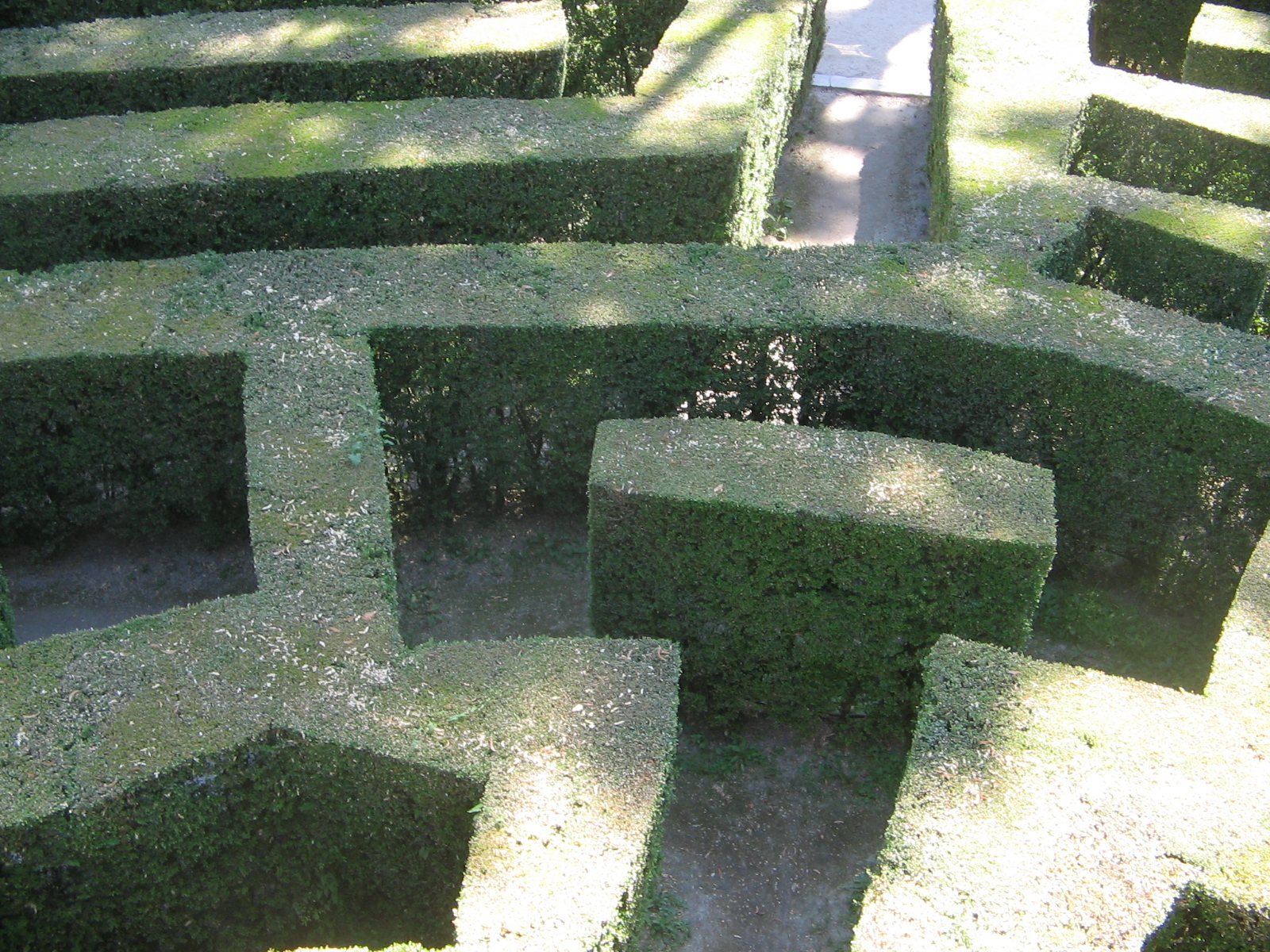
Hedge maze or stone? You decide!
Either way they're mostly skippable.
3. Skip to the Good Parts
Computer RPGs sometimes let you skip travel, usually as an unlockable advantage you gain along your journey. You find the airship, or you get the portal network back online, or whatever cheat will let you zip from Point A to Point B without all those inane random encounters between. Tabletop RPGs let you focus on whatever you want to focus on and handwave details that aren't relevant.

With a willing GM, you can always find a way to TRAVEL TO THE CAPITAL in an instant, or you can SKIP THIS ENCOUNTER SINCE WE'RE GOING TO WIN WITHOUT BREAKING A SWEAT. You've already defeated the Rat King waaaay back in Chapter 1, so why should you waste your time beating up a couple of refugee rats from that adventure? Computer RPGs keep track of details really well, but that advantage also spawns the Dark Side of Incessant Pedantry. Some GMs fall into that trap as well, but I've taken to handwaving the final few rounds of combat once it's clear the PCs have the upper hand.

Pretty walls are still walls.
Why do I play Tabletop RPGs?
As mentioned above, Tabletop RPGs let you:

  1. Do Anything You Can Imagine
  2. Change the Game World
  3. Focus on the Good Bits

With any other form of game, you eventually find the walls that define the game world. A board game can't reach beyond the confines of the board. A computer RPG will block you from specific areas until you're ready, and it will contrive to keep you under its control. If it doesn't have programming to cover what you want to do, it doesn't exist in the game world.

In a Tabletop RPG, you get to create the walls. If you share your table with adventurous souls, you don't need walls at all. If you want to have a gonzo planehopping game without serious PC consequences, have at it. If you want to create a world where butchers rule and processed meat products are used as currency, knock yourself out. If you want to explore possible reactions to a specific situation, you can replay a scenario over and over using different approaches.

You have control with Tabletop RPGs. Take it. Use it. Push the limits of your imagination and creativity.

But most of all:
HAVE FUN

Thanks for reading!

2011-06-14

The Low-Key Potluck

This past Saturday, it rained. While ideal for staying inside and playing board games, it also limited attendance as people were understandably reticent to travel. We hardy few tried out the new table protector and talked and ate and gamed.

Bananagrams
We broke the ice with Bananagrams.
Does that make us predictable?
Also, hilarity ensued, thanks to Steve.

We tested Belle of the Ball by Daniel Solis.
It's definitely a beta, but I think it's got potential.
My biggest issue? Very few cards actually score points.
I typed up some feedback and sent it to Daniel, the game's designer. And the next day I had a few more ideas for optional rules that I sent along. Daniel posted those ideas on his site to generate some more discussion about the game. For those of you interested in reading my email or joining the discussion, jump through here. And yes, having beta feedback published by a game designer makes me feel almost famous. (Insert a brief pause for fanboy squee-ing.)
Ticket To Ride ? Europe
We broke in Ticket to Ride Europe.
Tunnels, Ferries, and Stations add a
whole new dimension to the basic game.
Kim asked about the differences between Ticket to Ride and Europe, so I've made some edits here to talk about that.

Ticket to Ride Europe adds a few new elements to the basic game.
  1. Ferries require a locomotive or two to buy the route, so they're harder to afford.
  2. Tunnels introduce a little randomness into building. When you buy a route with a tunnel, you turn up the top 3 cards of the deck. For each turned-up card that matches the color of the set you just played (including locomotives), you need to play an additional card from your hand to afford the route. If you don't have any matching cards in your hand, you take your cards back and lose your turn.
  3. Stations let you "claim" a city and borrow someone else's route out of that city to score your tickets. If you don't use your stations, they're worth 4 points each at game end.
The Europe board has longer routes (1-4, 6, or 8! cars long) that fit together much more tightly making it much easier to get cut off, so stations become much more important. I got lucky with my tickets and didn't use any stations, so I ended up winning by the largest margin I've ever seen in Ticket to Ride. Ouch. I will gladly play again and have my pants handed to me.

We had a ball. Stay tuned for the next one!

All articles in this series so far:
- The Low-Key Potluck (See above.) (11Jun11)
- What we played this weekend (14May11)
- What have we played lately? (30Apr11 and prior)

2011-05-17

What we played this weekend.

We had another Potluck Game Day this weekend, and we broke out a fresh pile of gaming goodness and a couple of old favorites.
Bananagrams
Bananagrams in now a go-to game.
Sue us.
Carcassonne
We played Carcassonne for  the first
time in a while. It's hard to remove all the
expansions once they're in the tile bag.
Lost Cities
Lost Cities is a 2-player game we played
as a warm-up. Find the solitaire version on
Facebook and kiss productivity goodbye.
Scrabble: Junior Edition
I'm not sure which youthful variation of Scrabble
we broke out for the kids, but yay for spelling words!

Bohnanza Game
We've created bean-heads with Bohnanza.
Dunk, we'll keep your copy safe 'til next time.
Cosmic Encounter
This is the latest FFG version of Cosmic Encounter.
We played the 1977 version. Massive Old Sk00l, yo.
And after 34 years, it's still a great game.

And sadly, Mi Gato Se Incendia (created by Ben from Troll In The Corner) isn't on Amazon. Even sadder, the promo copy we had only had 1 Net card in the deck instead of 10, so nobody could capture the cat and win the game before the poor beast expired.

What games have you played recently? Would you like more details on how any of these games play? Any requests? We can certainly mine the game shelves and put things in the queue if you want some feedback. Please write a comment and let me know!

Per Chris J's suggestion, I've added links to Board Game Geek for each game. BGG has a pile of reviews and pictures for each game, and I really need to get my profile cleaned up over there. Do you find links to BGG helpful?

Each of these posts will be tagged with "potluck" for easy searching. And now you're informed.

Stay tuned for more hijinks as we play more. Thanks for reading!

2011-05-05

Idea Overload

Sometimes I'm asked, "Where do you get your ideas?"

Inspiration comes from everywhere. News stories, like yesterday's post. Song titles or lyrics. Watching people at work. Obscure holidays like Guy Fawkes Day. Thinking about church hymns. Watching my daughter learn about money. Sunrise on a train. Anything can inspire you if you let it. You can pick up ideas as easily as picking up fist-sized diamonds strewn across a beach, no matter where you go in your day. You just need to pay attention and accept what comes.

Ideas are the easy part. The hard part for me is developing them into something useful. Or some accurately finding the time to spend on developing ideas. I work. I spend 3.5 hours a day travelling to and from work. I spend time with my family. I sleep, most nights not nearly enough. I only manage to cram writing in on the train.

I'm trying an experiment this week - a blog post every weekday. So far so good - this post makes 4 in a row. But do the ideas I write about suffer for lack of incubation time? Or am I just tapping the huge backlog of ideas trapped in my head over the years I spent away from gaming? At this point I'm not sure it matters - it just feels good to write and get the ideas down on paper, even if the paper is completely virtual.

I think the zero prep model of gaming really fits for me. Many times I went into a session of my 3.5 campaign with only a vague notion of what happens next, like that game on Guy Fawkes Day. I came up with the idea of a group trying to treat magic as a fissionable material. The explosion demolished a mountain, but the party managed to remove the magic items and prevent more widespread destruction. In fact, I think that was the last game before Adris went on hiatus.

Point is, I didn't write anything up. There were magic items and barrels of gunpowder and shadow-walking red dragons guarding the Githyanki setting up the experiment. All of the stats were recycled from past encounters. The map spontaneously generated itself as we played. And the teleport just before the big boom rocked the house. Success!

Did it matter that I didn't write anything up? Not one bit. Everyone had fun, and if anyone caught on that everything about that adventure came flying out of my butt mere moments before it appeared on the game table, nobody seemed to care. Making the tools to pull this off seamlessly at the table is what I hope to document when I tackle Schrodinger's Gun GMing.

But blog posts are a different animal. They need to hang together a little more concretely, make sense, and be useful to the reader. Sometimes I feel like I'm writing for myself, which is ultimately true. There's no immediate feedback on the idea, no in-game tweaking based on player feedback. It's just me and the page, and sometimes the page wins.

Or more accurately, sometimes I can't get out of my own way and defeat myself.

Could I use more development time? Yes, many raw ideas need a little more time in the pressure cooker. But then I fall into the trap of never finishing. I can always edit ideas, but at some point they just need to be let free and see how they fly.

So let's open the door and see if this one takes flight.

And now I'm curious to find out if I'm a mutant or not. Care to share?
Where do you get your ideas?
How long do you let them steep in the teacup of your mind?
Do you edit and re-edit or just write them once and forget about them?
Are you happy with your process or do you want to change how you develop your ideas?

2011-05-03

What have we played lately?

My wife and I have gotten tired of not having time to play games and socialize, so we started hosting potluck gaming nights. Bring a dish, bring a game, hang out and play while the kids run the batteries down in our Wii controllers. Though I must say our kids have played a pile of board games as well, possibly more than the adults. If there's interest in games for kids, I'll get a separate post together with that list. Just let me know in the comments or any other method you know to contact me.

We've had 2 potlucks so far, and everyone seems to enjoy it. I live in a cape, so I fear when we get more than a dozen adults in attendance (three game tables in three different rooms, Bwahahaha!), but we have the deck for seating and socializing as long as it doesn't rain and the bugs don't carry anyone off.

I want to list the games we've played so far, or at least the ones I remember. For those of you who were wondering what that game was we played and where can I get a copy, here you go.

Bohnanza Game
Mmm... Beans.
Takes a while for an 8-player game, but still fun!
Ascension Chronicle of the Godslayer
Great deck-building game.
The randomness makes for easier setup,
but the group prefers Dominion's customization.

Bananagrams
Bananagrams Rocks.
And now we have a set. 
Zombie Dice
Yes, this perennial PAX East favorite
visited our table this past Saturday.

Ticket to Ride
Ticket to Ride - a great, fast rail game.
It took us some time to get up to speed,
but we had a great endgame - 4 players within
4 points until Longest Route was awarded. W00t!

On the Wish List for games to play in future potlucks, we have...

Dominion
I only have the Dominion base set.
Even so, you can choose available cards for
several different styles of game. Very cool.
*OP Car Wars The Card Game
Tasty Car Wars in card game form.
Now with even more mindless violence!
Brought it to PAX, but well worth playing more.
Dear Steve Jackson: MOAR CAR WARS PULEEZ!

Tikal
Tikal, the game of dueling archaeologists.
Another fun one I haven't played in a while.

Ben (of Troll in the Corner fame) brought over the prototype of Mi Gato Se Incendia (read more about it over here), but we have yet to try it out. Soon, Ben, soon. One of these days I'll print out Daniel Solis's Belle of the Ball and give that a whirl. Yay for printable PDF games!

And I've still got a half-room full of board games to play. Truth to tell, I don't care what I play as long as everyone at the table is having a good time. Friends trump games, but they make the games we play that much better for everyone. And eating piles of great food halfway through doesn't hurt either.

So if you're interested in any of these games, the images above are links to Amazon. If you click through and buy something, they'll give me a buck or two through the Amazon Associates Program., and I'll give you my unending thanks. Or at least a couple of bucks' worth of unending thanks. Or a lollipop, your choice.

As always, thanks for the eyeball tracks!

2011-05-02

Wombat's Path VIII: Why The Retrospective?

For my own organizational sanity, here's the entire series of Wombat's Path posts with links.


"So Wombat," you may ask, "why the heck did you write up Wombat's Path and document your gaming experiences over the past 30 years?" And you pose an excellent question.

The ego wants what the ego wants. I'll admit to shameless ego-stroking as a reason. What person with almost 3/4 of his life tied up in one activity wouldn't want to celebrate that, especially with a 30th anniversary coming up this fall? I'm not a slave to my ego, but the process of writing brought home to me that I may have learned something useful to share about running and playing games. That feels good to me.

Traveller Special Supplement 1: Merchant PrinceStill selfishly, I can mine these posts for blog fodder to expand on an aspect of gaming that I find interesting or useful. Finding topics and generating content for a blog can be challenging if you paint yourself into a corner. I'm purposely not limiting topics for this particular public writing endeavor. I've done so many rules hacks on the fly while GMing that at least one of them could make sense to you. So many times I have wanted a supplement that would cover something missing in the rules as written, so it makes sense to expand on or add a system that would increase the depth and enjoyment in a game. So I'll do exactly that in this place as much as I'm able. I may not know what you'll find useful, but I hope I can solicit your help to guide me.


Contrary to the beliefs of 17-year-old me, history is important. History teaches newer generations about previous forays and failures, and hopefully saves some trial-and-error time when working on new ideas. It gives us a sense of what's come before and a sense of involvement in something bigger than just the people involved. However, 17-year-old me got burned out on 5 years of American History that studied battles and skipped over the meat of motivation.

On a more altruistic note, documenting my game experiences brings my past into focus and make me think about how my gaming preferences have matured over the past 30 years. This gives me a well of learned lessons to draw from as I try to share my experiences where appropriate. Not everyone games the same way, and not everyone cares to hear advice. Though in the cases where people need help, I'll do my best to get you where you need to go.

Munchkins Guide to Power Gaming (Steve Jackson Games)
Yummy gaming book!
Order 2, they're small!
If you have any questions about GMing or comments about anything I've written, don't hesitate to get in touch and I'll do what I can. I will answer, even if it's just a quick "Thanks!" You can leave a comment to any blog post, or twittle me at @twwombat, or email me at jim (at) twwombat (dot) com.

Yes, I'm playing with pictures linked to my Amazon referral account. Sue me. Or better yet, click through one of them and the Google ad to put a penny or two in my account and then hop in your '91 Indignant Huff and drive away. I think the pictures add a little graphical oomph which is great for a non-graphics person like myself. Also, please let me know what you think about the new background I put up in the past couple of weeks.

Thanks for reading!

2011-04-20

Wombat's Path VII: Then 'Til Now

After college I joined the work force and started a 9-to-5 job. Employment tends to push gaming events to weekends, a fact which still makes me sad at times.

I started a game using the Hero rules set in modern-day central MA. I set it in Puck's prime material plane, so extrapolate the oddities from there. I had aliens named after viking runes running around. Around midwinter they tended to gather to celebrate the arrival of their first emissary named Wunjo, same as the Norse rune of joy. Alien Jesus is the name of my Ministry cover band.

The party came together to investigate the theft of an ancient Aztec cup, and they discovered the thief that could walk through walls. They tripped across a half dozen other plotlines and suddenly had too much to do - sense a trend here? I remember them hotwiring a car from the Smithsonian parking lot and escaping to Egypt ahead of a retrieval team from a shadowy government agency.

People started gaining powers, including the PCs. One used the cup and took on fire powers. Another had the chance to partner with a demon to get shadow powers, but declined. They traced it back to a group of friends working on a virus to treat disease. It backfired and started the Wild Card virus. The PCs were contagion vectors, so wherever they went they left a legacy of superpowers behind them. They took a bus in London, and the driver developed precognition, giving him the safest bus in London.

Real life swept me along and I let that game go. A few years passed, and D&D 3e came out. I decided to start a test game with a few friends to kick the tires on the system. I downloaded the first demo adventure from the Wizards site, the one with the mine and the magical disease in the well, and went to town with 5 friends. I set their base in the small town of Adris, an outpost at the far east of human control wedged between the Dwarven mountains and the Elven forests. It turned into the longest campaign I had ever run, spanning 5 years and involving 7 active PCs.

That evolution gave a depth to the game that I haven't had anywhere else. Sure, I have set 4 games in Highcastle, but that only gave a depth of history and setting, not the intricate meshing of PC and NPC actions that I got from the Adris game. The players and their characters meshed with the plots and loose ends and made something greater than the sum of its parts. They generated a sense of history and continuity as they gained their 14 hard-won levels, and I have a 32-page timeline of bullet points covering what the PCs did during the game.

They tripped into the quest for an ancient artifact - the Seven Cubes. They're actually hypercubes, each with a different colored "inside" cube tuned to a different god. They've got six of them already and have experimented with using them together, which produces some spectacular effects. The purple one channels power, spell or otherwise, the green one manipulates life force, the red one controls fire. If you stick the three of them together, you can lay waste the undead hordes with purifing flame. So 14th level characters can generate epic-level spell effects by combining cubes.

Then I became a father. Actually, five of us in the gaming group became parents within a 2-month span. We played a game or two with the kids, and none of us could concentrate on the game. I let the game go fallow and decided to concentrate on my daughter. That was almost 5 years ago now, and I have gamed very little in the intervening time. It was a choice, and I decided my family comes first. Now to get my daughter gaming.

The itch to run a game gets stronger with each passing day. I feel like I've let a big part of myself go for too long. I'm afraid that my GMing skills have rusted over. I'm like a new GM all over again, with the same self-defeating question: "What if my game sucks?" To even ask the question implies an internal no confidence vote.

Screw it. The Adris game is coming back this summer. I want to get the story told and put it to bed. I want to have a game wrap session where everyone can ask about all the plot threads that went by the wayside during the course of the game - there's so much unexplored opportunity in this game that I could run several other games in the same town without breaking a sweat, and I think that's awesome.

There are other opportunities and ideas floating around. I want to run an epic-tier 4e Dark Sun one-shot game. I've been toying with metagames, where players can control kingdoms like the old D&D Birthright setting. I'm playing with the Leverage rules and thinking up mods to run Travelleverage with tramp freighter crews in  the late Imperial era. There's been call for a Gweepling game which I'm thinking about organizing since most of our social group's kids are in the 5-10 year range. So much opportunity - I hope I can capitalize on half of it.

Look out, gaming world. The Wombat has returned.

Next time: a retrospective of the retrospective, and where we go from here.

2011-04-07

Wombat's Path VI: The LARP Detour

I've mentioned some of my LARP playing experiences back in Part II and again in the previous post, and I think I'll dive a little deeper here, specificaly on the GM side of the house.

Hell Week was my first LARP. I had no expectations, and I had no idea what the heck was happening. I knew there were 50ish players, each with their own agenda, and I knew it was going to be a long week. I bought into the world and went with it. Maybe theater had prepared me, but the game came to life around me as I played. I knew I wanted to create that feeling in others.

So a group of us got together and started writing a sequel to Hell Week. We called it Every Now And Again. We took some of the characters and spun a different world. The secret white circle of mages had a hideout in a hollow mountain in Tibet. Characters had guilt to get over, a god to bring through to earth, and a world to save. Sprinkle in time-travelling fugitives trying to build the wave motion gun and time cops trying to keep the timeline in existence, and we managed to push the game over the top.

Mistake #1: We kept it a week-long game. We could have run the same game in a weekend, and the plots would have unfolded much faster. Players had no motivation to do things today when they could get more people together tomorrow.

Mistake #2: Overpowered characters. Yes, we gave the time police an aerosol can of Plane-B-Gone to use if the timeline got too corrupted. See also the afore-mentioned wave motion gun. Police carrying enough explosives to take down a mountain. Things got a little crazy, but the players did well in not abusing these obvious game-changers.

Mistake #3: GM Preconceptions. There were a few scenes we really wanted to see when we wrote the game. A few came true, but we eventually rose above our expectations and gave the players more power to change the world as the game went on.

Mistake #4: Retconning and GM Communication: Half the players were involved in a massive muckle that the GMs botched slightly by giving different rulings on different sides of the conflict. We had to turn back time to a previous round and re-run it. Not a proud moment, but an informative one. Once spoken, rulings are very hard to change.

Most people had fun, or at least they didn't burden the GMs with their complaints. Or maybe it was the sleep deprivation blotting out all memories of unhappy feedback. We pulled it off. Half the GMs and a few players wrote the next game in the series, called It Was Better In Real Life.

Sometimes called the Hell Game, it was set in hell. Lucifer set up the bureaucracy of Hell with all its devils and all its intrigues. He was being visited by the Nameless One, the head demon, and his contingent of demons. I played B'Naagh, the biggest demon there was. He couldn't find two neurons to smash together, but boy could he destroy things real good. He was a whole heap of fun. I was more of an NPC - more set dressing minion than story motivation player, but that's an underappreciated role in many things.

And after the first run, I got talked into being a GM for the re-run at Arisia. We expanded to 65 players. We polished the rules. We balanced stats and re-wrote bits that didn't work. We worked out the cosmology and where all the players fit in. We kept the One Door in Hell and figured out something that would make it special for players who like to tinker. We went to the con with the idea of setting up in the afternoon and printing out all the character stat cards for the evening start.

The printer broke.

We handed out character packets, but since nobody had stat cards we declared that there would be no combat on the first night. This bothered some people, but almost everyone dove in to role-playing and intrigues. It was glorious to behold. Players in character taking risks because there would be no combat that day.

The printer breaking turned a decent experience into something really memorable. Granted, many players would have liked to have stats since some of the game revolved around the arena fights, but I think the players decided to have fun and lo, it was fun.

LARP Lessons


LARP focuses more on player vs. player plots. LARP runs differently than tabletop games do by design. In a tabletop game, the GM plays the world and the players struggle together. In LARP you set up factions of PCs to compete against each other and come to some sort of resolution or accord if possible. The PCs work together on some things and come to loggerheads on others. And never underestimate the real-life history between players that will bleed into the game.

LARP tends to be hands-off for the GMs. With so many players, it's impossible to give every player a solid dose of GM attention, so the players have implicit carte blanche to decide what happens between their characters. The combat system (or conflict resolution system) only comes into play when the players can't come to an agreement on their own. We go back to the pure form of pretending to be cops and robbers and arguing out what should happen next, only without quite so much whining and with a system to fall back on if we really can't make it work on our own.

LARP requires heavy design-time effort. If you don't plot out the game and give your characters motivation, you will not have a LARP. You will have a social event in costume. Without the organizations and intrigues that get built into the start of a game, it falls flat and the players either wander off in boredom or decide to take charge of the game and steer the game very far afield from the initial conditions. DO not improvise your LARP or you will regret it, with very few exceptions.

How can we incorporate these lessons into tabletop games?


Let the players drive the story. Nothing new here, but it bears repeating with all the push for player empowerment I've heard lately. I've heard this idea spread like an epiphany in the past few months, but LARP has been pushing this idea since the beginning. Trust your players to make things. Trust them to change your world in significant ways. Let them try whatever they want and sort out the consequences afterward.

Let the players debate each other. If you've set up character-driven plots, characters will naturally argue their case with each other. This deepens the characters and lets the players get more involved with the story. Player investment is the holy grail of tabletop gaming. If the players aren't interested, you're running the shell of a game. LARP focuses on character immersion - you are your character to the bone during the game. Letting your tabletop group debate decisions in character strengthens the player/character connection and will give everyone at the table a greater affinity for your game.

Yes, this can go too far and your players could start mudslinging or breaking the party apart. I've found it helps to have an NPC at the table or at least waiting in the wings to talk frustrated characters back from the ledge. People are people, real or fictional. People just want to be heard and to influence their world. PCs have it better than most since they are designed to change the world from the start of every game. Let them be heard and get the character frustrations out on the table for all to work on.

Design once, implement anywhere. I'll be expanding this idea when I get back to Schrodinger's Gun GMing. GMs put a great deal of effort into adventures and settings and maps and plot hooks. The players don't know what's around the next corner until they get there and take a look. So what's to stop you from filing off the serial numbers and modifying the circumstances around your adventure for use in unexpected places?

As GMs we do this the other way all the time in modifying off-the-shelf adventures to fit our campaigns. We rename NPCs and have them become recurring characters. We change affiliations and have someone be part of an existing group in our world. We change monsters since bugbears don't exist in our world we plug in gnolls. We add treasure and give them another section of the Rod of Seven Parts. What's to stop us from retooling the adventure to fit the situation?

Consider a tomb. It's a hole in the ground with a corpse in it. Perhaps some monsters have moved in and maybe a few coins have accrued. You can use this anywhere and it'll fit in just fine. Need a quick side quest to get the Maguffin of Plot Motion? Run the tomb. Returning remains to their rightful place to settle a ghost? Run the tomb. Bored and exploring local legends? Run the tomb.

It fits anywhere, and it'll save you the trouble of creating a different hole in the ground for every side quest. GMs have been very green since the beginning. Reduce the amount of prep since players will go their own way regardless of your desires. Reuse what you've already created in different settings. Recycle already-run adventures and mine the results for future NPCs and plot lines.

I've gone a bit far afield here. Hopefully there's something here you can take and use in your own game. Feel free to follow up in the comments if you've used some of these ideas or if you can't imagine how they would fit into your game. I'm always up for a good discussion.

Thanks for reading!

2011-03-25

Gaming Maxims

OK, intarwebz. I've heard that you're at least mildly interested in manifestos, so I'm looking for the ultimate gamer's manifesto. If you have a link to something that you simply adore, please share with the class in the comments below.


Failing finding a pre-packaged page of gaming yumminess, I'll compile a list of gaming maxims. Which means I turn to you for input. I'm looking for the guiding principles you bring to a game and any quick snippets of wisdom that resonate with you when sitting down to play. What quote always rings in your ears when you're gaming? It can be for RPGs or boardgames, for GMs or for players. Doesn't matter to me.


If it's uttered at a gaming table and everyone nods and says, "True dat," I want you to take the 90 seconds to type it in and share it in the comments below. Please leave me enough info to credit you for your contribution.


Once I have a critical mass, I'll compile the quotes and post a link to them here and on Twitter and Facebook.


Here are some of my favorites:


- The story always trumps the rules.


If it fuels the story and makes the game richer for everyone, I’m all for any changes players want to make.


- Roll the dice only when role-playing has failed.


- Wheaton's Law: Don't be a dick.


- Let the Wookie win.


- "Mama needs a new pair of shoes!" *roll dice* "I got a rock."


I can't wait to hear what guides you at the table. And thank you for taking the time to read and respond.

2011-02-17

Wombat's Path V: To All The Games I've Played Before

I'd like to take a detour away from GMing here and say a little something about some of the other games I've played. Yes, most of these were in college, but since we're coming to the end of my time in college in this retrospective arc, I thought I'd take a look back and keep the games I've played fresh in my memory. Time is fluid, and so is my order of listing.

So-Ahc. I played in a few LARPs set in the energy world of So-Ahc. Yes, it was directly based on Hell and every character fit into the infernal hierarchy somehow. I played Lord Modeus (AS if you couldn't tell my character's namesake) in the first game. I played with the mechanics - I remember a tournament for control over a suddenly-leaderless city-state. One of my powers was to make a subject grovel for a round. I took the groveling as evidence of submission and won that particular contest in one very-cheap-in-so-many-ways shot.

I remember playing a follow-up So-Ahc game at a con in DC, where I played Modeus's father who had dreams of uniting all the city states, under his rule of course. I took more of a diplomat role and ended up with 80% of the world under my control. Not a bad weekend's work. I remember never using the combat system - if I did, it meant that I failed as a player top advance the story on my own.

The Crystalmas Caper. I made a couple of characters for this game. The first was a cleric of Ralishaz, god of chance. I took a fatalistic view of his worship and managed to limit my roleplaying options - I played him once and didn't have fun. I could have changed the character, but I started a different concept: Corpus Ghoiti, the con man with a combined Int and Wis of 16. "Fish" worked like this: "Follow me!" Disaster ensued. There's nothing better than having the charisma to convince everyone around you that your completely-flawed plans will work flawlessly to design. And he never learned, which makes him endearing as all get-out.

Also by @verdammelt, I played in the Victorian era Call of Cthulhu game. I played Victor Metcalf Collins, an ex-strongman refugee from the circus. He was a bulbuously strong pugilist. We created characters through story, not mechanics. We talked it over in one-on-one sessions and never saw our character sheets. We knew what our characters were capable of, but not how well-trained we were. I remember surprising myself when I rolled an 80 (the equivalent of a 4 on a d20) and still punched through a zombie, dropping it in one hit. "You said you were very strong and a good boxer." "Yeah, but I didn't think I was =that= good." The journey of discovery applied to our characters as well as the world.

The Masks. We played ourselves, transported to Dunk's alternate world with whatever we happened to be wearing and carrying at the first game session. I wore a navy coat and lieutenant's bars, so I inherited the military insignia of the other world: very prominent facial tattoos. That was a tough trait to work with, since I was still a 6'3" string bean with very little martial training, and I had this glowing beacon advertising that I could fight well. Yowza.

The Bird Is Wise. Shawn's dark and twisted alternate-now world actually stole from a dream I had to great effect. Some of our professors played with godhood as part of some sort of cult. Come to find out, our world was one of many "nests" watched over by bird-like gods. I ended up in the throne room of my nightmares, with an army of slaves in the courtyard below, facing down the current iron-fisted "bird" ruling over our world. We managed to beat him, and I ascended into godhood at the climax of the game. A kickass ending in the best possible go big or go home sense.

I will always be grateful to @huzzah70 for making Traveller come alive. It takes a Navy man to navigate the awards and decorations during character creation, and his insight into the real-life process really brought the services into focus for me. Now if I would have settled for someone slightly younger, instead of the forced-into-retirement Admiral I ended up playing. Good times.

Shadowrun. So many different games of Shadowrun (OK, 3), but all of them were tons of fun. The one scene that keeps replaying in my head goes like this: *jack in* "I am the building." "How very Zen of you, Maddog." Runner rules were always another game unto themselves, which made the separation of hacker vs. hitter very jarring. I remember playing a raccoon shaman washing his food the way his totem would at a black tie dinner. I remember Blitz, my elven physical adept fixer. I remember laughing my ass of with friends.

Many other homebrew tabletop games flew by, most of them one-shots. I really appreciated Eric's game with the magic system that required you to make up a rhyme for a bonus/penalty to your magic roll.

And how can I forget the Champions arena one-shot: 8 players enter with 3-man teams of characters, one player emerges victorious. I foolishly went for speedsters across the board, and the first 12d6 area attack in the first phase turned the entire team into a fine red paste. Funny, but ugly.

Car Wars kept surfacing throughout and after college. I added character rules and ran a couple of games, but mostly the wheeled carnage trumped all. Especially that one game when Ken earned the nickname "Crash n' Burn." He did a fairly easy D3 turn and had a 1/6 chance to skid. As he skidded, he had a 1/6 chance of losing control. As he lost control, he had a 1/6 chance of rolling the car. As he watched the road spin by out his windshield, he had a 1/6 chance of catching on fire. As the flames licked his armor, he had a 1/6 chance of dying. At the funeral we all commented what a senseless death it was.

There are many others running around at the periphery of my memory, but these snippets jump out in sharp contrast to the haze to which my memory defaults. My apologies if any omission offends, and I'm sure I'll be shaking the memory tree more in the future.

2011-01-26

Wombat's Path IV: Focus On Story

I had burned out on GMing, but it was in my blood and wouldn't let go of my brain. I took some time off to throw myself into theater, but I couldn't stay away for long.

I ran a very casual game for the home crowd which I dusted off for the college crowd: Wumpus Quest. Everyone made evil characters and tried to track the 50-foot-tall hairy philanthropist known as the Wumpus. The evil bard had a hard time coming up with rhymes for "pestilence". Zany cross-dimensional things happened. One time the characters used a portal, then woke up from cybernetic implant surgery an instant later. Boy, did the elven assassin love her retractable claws.

Wumpus Quest had very vague, handwavy rules. Character creation used AD&D with a rough point buy system for racial attributes. The beholder mage had all his eyestalk powers, but every stat except Int got bought down to 4. That lack of rules liberated me to shorten the time between idea and implementation: if I could imagine something I could use it immediately. I let the game take me where it wanted to go, and my players laughed. Win.

I wanted a deeper, more story-driven game. I had a few players interested and committed to a fantasy game from the Gamut, so I plotted for a bit and dusted off Highcastle as a setting. I went out and bought a single dark green d20 and told myself this was the only die I would use for the entire game, damage rolls be damned. I spent a couple of hours with each player one-on-one for character creation and pre-game mini-adventures.

The party came together slowly. An aristrocratic family-oriented son of a fighter guildmaster, resplendent in his full plate. A schooled mage summoner with the school's pentagram etched in his forehead. A bald priest of Kreigan walking the middle path between pure martial ability and mystic ability. A well-connected bard looking for source material for his masterpiece. All drawn in by fate and Puck's busy hands.

These characters had depth. The world came alive. People around them died and the characters mourned. Lizardmen and dragons invaded the city and were eventually repulsed back to the sea. A mysterious order of knights took to rebuilding a town on the coast, under orders from a beholder. The aristocrat earned titles and an artifact, much to the chagrin of the political and religious establishment. Intrigue abounded.

I handwaved combat by listening to what the players wanted to do, then assigning a success range (sometimes odd ones like "even numbers 10 or higher") and rolling a single die to determine how well they succeeded. I thought about what the characters could do and went from there. Story led the way and burned away all the rules that slowed story down.

It was the fourth game I had run in the Highcastle setting, and I think it was the best game I had run. What made it great? I started with a more measured, linear approach to the plot. I had a page of possible plots prepped, planing to dole them out as time went on. The pacing felt a little slow and I felt like I was losing focus. And one night, I decided to do a  little experiment.

I remember thinking, "Why not introduce every plot I have and let them choose what to focus on?" So in the course of one 4 hour session, I threw the threads of 20 plotlines at the characters. Everybody had a handful of potential adventures (most of them time-sensitive) drop in their laps, one or two from everyone they knew. Some tried to take care of things on their own, but quickly realized they needed the rest of the party to help. And when they got back together, the discussion about what to do next got so intense that I knew I had a winner.

The game wound down with a climax that felt a little anticlimactic, and we all worked out what happened to the characters post-game in a little epilogue. It completed itself, and I really enjoyed the intensity of the game. It felt great to focus on one game and explore the characters and setting very deeply.

Yes, I'm going to go back to writing about dealing with time crunch for PCs. It's an approach that has worked for me since that Highcastle game, and I need to solidify some of the ideas around it. Some of it is just common sense, but as someone wiser than me has said, "It seems that common sense ain't so common." I'll assume nothing about your ability and go from there.

More in the next installment. Heck, I can't seem to write myself out of college yet.

2011-01-19

Wombat's Path III: Sophomoric Pursuits

Immediately after Hell Week, a few of us started talking about how our characters would progress after endgame. We couldn't stop thinking about all the possibilities. And so we talked, we planned, we plotted, we fleshed out groups, we made goals, we wrote. The next year Every Now And Again (ENAA) came into the world.

ENAA told the story of the next chapter in the lives of many of the characters in Hell Week. It was set in and near a mountain in Tibet. We added whatever we could think of - characters could build the Wave Motion Gun, and the Time Police had a can of Timeline-Be-Gone in case things at this historical nexus got too out of hand. We had a dinosaur spirit ascend to demigodhood during the game and start creating primordial swampland.

The power was out of control, off the charts, and through the grace of our 60 very patient players, somehow the game still worked. Yes, there were issues and the GMs had to retcon a few rulings, including one muckle involving about half the players, but by and large people had fun. It ran almost a full week, and that was probably too long.

I was proud of the combat system, dubbed "Wombat Combat". I was proud that we pulled off a game of such magnitude, even with all the problems.

We learned many things.
1) In any game with many players and causes to fight for, eventually you'll get a lynch mob invovling about half the players.
2) The lynch mob will probably change causes at some point, possibly even pull a full reversal in order to atone for their misguided first attempt at dispensing justice. This second mob will be even uglier than the first.
3) There is such a thing as too much power in a game.
4) Players will adjust the pace of achieving goals to match the time they think remains in the game. We could have done the exact same game in a weekend and had a much tighter run.

All in all, it felt a little like The Two Towers. Stuff happened, but not much got resolved in the span of the entire trilogy arc. It served as a good background builder and gaming experiment, never to be run again.

After ENAA, we didn't know how to top ourselves. I had burned out a bit and didn't write the next game in the series, called It Was Better In Real Life. Wombat Combat didn't need more than a few tweaks, and it was reused wholesale. More on this game later, as I jumped back in to help rewrite it for Arisia.

Instead, I decided to do something insane on my own. I had this multiverse that I created back in high school run by 8 gods. I had run a few tabletop games, each of which fit somewhere in that multiverse. I was looking for something to do, as I wasn't really engaged academically. Why not run a bunch of games simultaneously across the whole multiverse?

Wombat's Gamut O' Games came into existence my first junior year in college. Yes, WPI is a par 5 school, and I lost my way with physics, my major. Soul searching ensued, reserved for an entirely different forum.

With the Gamut, I used some LARP tricks to lighten my load and engage more people in the game. I cast friends in several NPC-style solo roles with their own motivations. I cast friends as the gods and had them personalize their planes and help set up the main world for the players. They had a big plot to deal with - one of the gods went missing and couldn't be found. I had 32 PC slots and I planned to run one session at least every other week to keep the action moving. I had this vague notion about all of the PC groups coming together somehow to prevent some cataclysmic event, but nothing more than that.

I had about 50-60 roles in my head, 8 gods, 32 PCs in groups spanning genres (fantasy, cyberpunk, modern-day detective, superheroes, mecha, etc.), and the rest solo roles. By the time the whole thing fell apart from its own immensity, I had about 35 people involved. Even running at just over half capacity, I ran something all the time. My solos were setting things up via email or little one-on-one sessions. I had 4 groups of PCs running fairly regularly, and my team of gods had some awesome ideas. I literally lived the game.

Fun, but not a sustainable experience, especially with things like classes in the mix. I burned out again. Maybe there's something in me that craves too much responsibility. Again, more soul searching not appropriate for this forum.

I was cast in It Was Better In Real Life as B'naagh, a big nasty demon. He was a brute, probably the strongest character in the game, and he had a hard time with concepts involving multiple words. He was an absolute blast to play, and exactly what I needed.

Concidentally, around this time I was cast as Owen Musser in The Foreigner. He was the quintessential redneck bigot, and the main bad guy in the play. Again, tons of fun to play. I managed to chew up coffee stirrers into little mangled blobs of plastic every night to get into character.

About this time, the word "sequel" became taboo. We had to replace it with "Sasparilla" because our player base was tired of the same characters in the same world. The community grew, and many others jumped on the LARP writing bandwagon.

But more on those experiences in the next segment.

2011-01-14

Wombat's Path II: Off To College

College: The process of a young person trying everything in hopes of finding something tolerable to do that might actually pay well while suffering under a crushing load of homework and figuring out how to navigate shark-infested social waters.

I bloomed in college. High school saw the start of that, but I didn't get to really branch out until I moved out. Gaming and theater gave me a place to start, especially at a tech school like WPI, and especially back in 1987 when I arrived.

The first week I was there, I wandered the halls until I overheard someone talking about Melf's Acid Arrow. I poked a head in and told the three young men in the room that Melf was an old friend of mine and could I play too. I rolled up a gnome cleric/thief and we got to rolling dice.

I only played a couple of sessions. The GM definitely approached the game very differently than what I grew up with. Everything about the experience - the table talk, the attitude, the ever-more-deadly encounters that had no flow and no raison d'etre - spoke about how the GM and players could never work together. I didn't know how to react, but I knew I couldn't stay.

The party got to a room with a lava-filled fissure with hordes of demons crawling out of it. He asked me what I wanted to do. I responded, "Well, I throw myself into the fissure and sacrifice myself to the dark god. Here's my character sheet. I need to go."

In retrospect, I can see the childishness in my response. Then again, childishness filled that particular game. I didn't keep up with the GM - I felt a little betrayed about the whole thing - but I did manage to start gaming with the rest of the players who quit about an hour after I did. I dusted off Highcastle and started a roughly-D&D rules-light low-level game.

Halfway through my freshman year, three things happened. I got a part in my first-of-many shows with the theater group on campus, significant since I ended up with a theater degree. The Science Fiction Society elected me president of the club, the outcome of a purely political move to block a faction that wanted to shape the club after the MIT Assassins' Guild but still surprising. I played my first LARP, run by the people who wanted to shape the SFS after the Assassins' Guild.

It was called Hell Week, a play on hazing rituals but in this case involving the actual opening of Hell itself. Piled high with WPI-specific references and pun-filled character names (I played Herb I. Vorr, a parapsychologist from California, and that's a tame example), loaded with character information scribbled onto 3x5 cards run through a line printer, clunky, barely cohesive, run by three sleep-deprived maniacs who could barely hold themselves together, It Was A Glorious Experience.

I bought the world. I bought the weirdness - my character investigated weirdness and was a member of a circle of white mages, so no big surprise there. I bought into the experience. It ran for a week, 24x7. Ambitious and downright insane, but it worked.

I will always remember about mid-week, when the forces of darkness rallied all the popular support to their side, when the three white mages and the two Priests of Elvis were forced into hiding from hordes of undead controlled by Michael Jackson cultists, I hid in a friend's apartment I had never been in before hunched on the toilet with a card for a teleport spell in my hand and ready to use. The adrenaline shook me awake for days.

Glory.

This cemented my thought that you can dispense with the system if the story of the game compels you enough. Since the GM's time runs short far too often, it's up to the players to work out what happens in the scope of the game. Theater-style LARP really encourages the players to work it out on their own.

I've taken this lesson into my tabletop games in various ways, but more on that in future posts...

2011-01-07

Wombat's Path I: The Early Years

For those of you who are curious, Gaming and I go back a ways. Please feel free to skip off to something more exciting and relevant if navelgazing offends or bores you. I won't be offended.

My first game was the purple box D&D basic set that I managed to pick up sometime between my birthday and Christmas of 1981. I was in middle school, 6th grade to be exact. I think the D&D set was a bribe fom my new stepfather, though the details are fuzzy. I could write, but I had a hard time writing on topic. I had ideas and no concept of how to express them effectively. And then I read the D&D rules.

The rules covered interactions with the world and doling out ever-better abilities to characters. Other than that, your world bent to your will. D&D gave me a framework to fill in, a sandbox to play in. For a son of divorced parents where every year meant a new school system, it gave me a place to develop myself independent of the outside world. Writing and adventure design started to have deeper meaning because it served my internal world.

I started buying AD&D books with Christmas money. I biked down to Spag's in White City and picked up cheap rulebooks. Who cared if the price was scribbled inside the front cover with grease pen? The information opened worlds to me, especially the random dungeon tables in the back of the DMG. I spent days after school filling oversized pieces of graph paper with rolled-up rooms. I fudged my own rolls. I remember fudging a Flame Tongue sitting on a table in the middle of an otherwise bare 20' square room.

I started mashing games together, eventually ending up with the Outdoor Survival board covered with chits that would transport me to another board game (Wizard's Quest, or Feudal, or other more dungeony games I've forgotten the names of), where I'd beat the monsters and take their loot.

It took me a year of exploring the D&D and AD&D systems in my own head before I started gaming with friends. I reveled in my control freakishness and was afraid of letting others touch my creations. Stupid me. I played one-on-one with my neighbor and best friend, Mark. We fought bad guys. We overcame obstacles. We created and enjoyed piles of magic items.

We created memories.

D&D is a game. It's supposed to be fun. If it isn't fun, change things until you have fun. Sure, those early years were clunky and some of my rulings were ham-handed or overly generous. But getting together and having fun trumped the rules.

Mark went through his own family reorganization and moved to California. I found other gamer friends in high school. We had a solid group of 4-7 people that got together a couple of times a week, and we played everything we could get our hands on: D&D, Dark Sun, Spelljammer, GURPS, Champions, Toon, Psi World, Rolemaster (once - too many tables for us). Everyone took a turn GMing.

Phil ran a by-the-book Greyhawk AD&D game with time travel that rocked the house. We broke out Toon, where Keith named his character "Oh, Shit! The Penguin's Got A Gun!" Kev put together rules for different flavors of magic, and I gleefully played a Bandarin Mage who brewed spells into potions and caused all sorts of havoc (more playtesting needed to limit power with something other than money).

We hacked rules, made new stuff up, took the books as a base and modified everything we could think of. Those were heady days, the wild west of gaming's roots. Nobody could tell you what you were doing was wrong, only that they didn't agree.

We had serious moments where we learned the difference between interacting as friends and interacting in-game as mercenary characters. We had nights when we couldn't stop laughing. We had contests to see how many Sour Patch Kids we could hold in our mouths without crying.

I loved generic rulesets - I started writing one until GURPS came out 2 weeks later. Hero and GURPS handled cross-genre games fairly well, but they had very different philosophies and methods. That got me thinking about the divide between system and setting. You can skin a setting and put a different ruleset behind it, though it changes the flavor significantly. I didn't fully understand that until some interesting discussions in 2004...

I gamed and acted in musicals every moment I could. Even with my downtime I could organize my thoughts and build new game experiences. The shower helped me design worlds and cities and cultures. I basked.

Important things came out of my high school years, things I still use. Monad rules the multiverse leading the 7 lesser gods: Kreigan, Aberroc, Puck, Tremas, Shoshen, Dreiden, and Darro. I made a segment of a ringworld (thank you, Larry Niven) and populated it with refugees from a broken earth thousands of years in the future. They discovered magic and melded it with technology, and almost blew the world apart until the elves started taking an active non-technology interest in things. Elves usually have their three-letter clan name as a hyphenated prefix before their given name.

These things shaped me. I took what I wanted and modified it to give structure to my game. Ideas ran rampant. I had so much fun, and I wouldn't trade those wide-open creative days for anything.

And thank you to everyone I gamed with prior to college. I cherish every experience.

I'll break here to organize my thoughts about gaming in college. Suffice to say, things changed.